 Download the Event Tech Forecast now


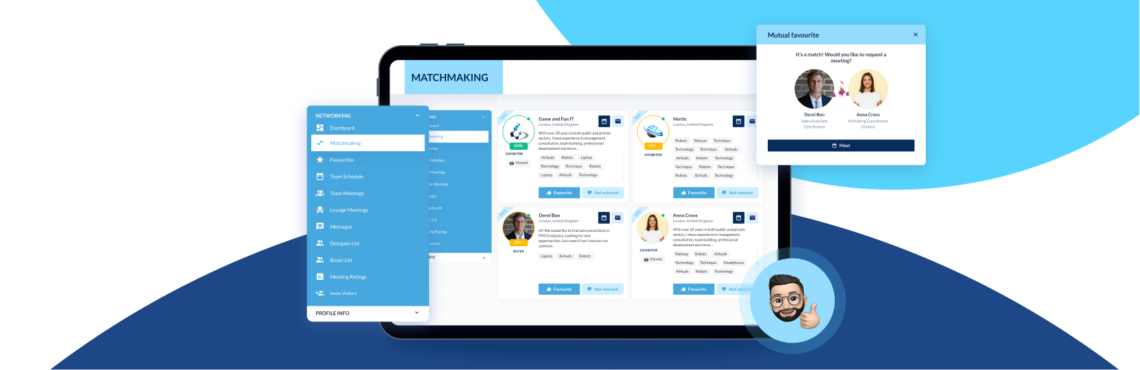
How AI Matchmaking helps you create successful events
The world of meetings and events has become more fast-paced, dynamic and complex over the last few years.
There are many moving parts, including sourcing venues, securing speakers, designing marketing collateral and following up after the event.
For a successful outcome, organizers must create tech-enhanced Smart Events for an audience that demands richer experiences.
A crucial component of these smart shows is AI-powered matchmaking that massively improves networking for the attendees.
Over the past decade, artificial intelligence (AI) solutions have become widespread across different industry verticals.
These advancements have led to innovative AI solutions in many businesses – including matchmaking for events and exhibitions.
AI matchmaking uses intelligent algorithms to connect attendees to relevant exhibitors, companies, and content.
This takes much of the grunt work off the individuals’ plates so they can focus on other aspects of the event.
Throughout this guide we will cover the following areas:
- How does AI matchmaking benefit events?
- The new way of business matchmaking
- Person-to-object matchmaking
- Conclusion
Let’s explore how AI-powered matchmaking will continue to be key to creating successful events in the future.
AI matchmaking is necessary for events
In-person events are thriving but are increasingly tech-driven.
An increased use of event management platforms to plan such events means the average exhibition or tradeshow is now generating more data than before.
The data includes the registration details of the participants – name, company, job title, geographical location, as well as their interests and preferences.
This vast repository of information is at your fingertips, but the question is how do you use it to drive the right connections and enhance networking opportunities?
Processing all this data manually is a Herculean task that involves long hours.
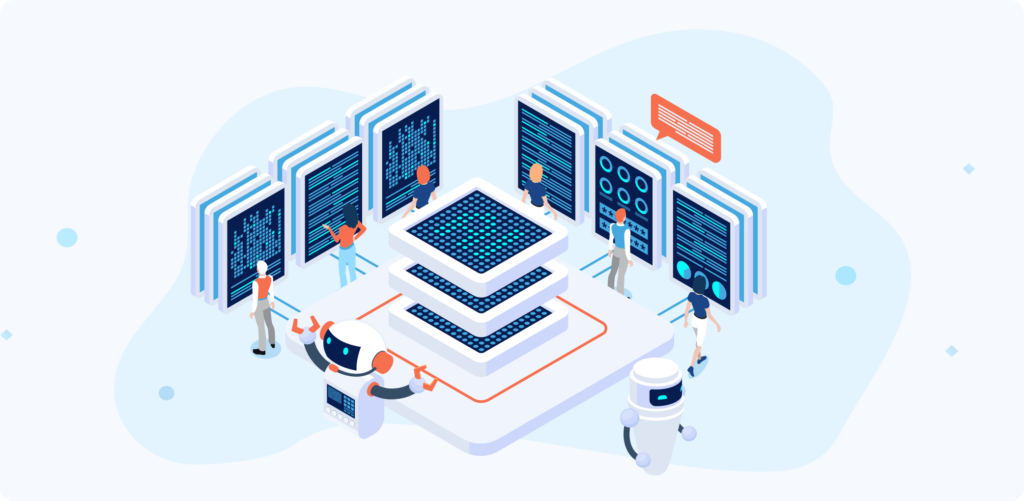
With AI matchmaking software, millions of data points are analyzed within seconds to deliver instant recommendations.
At the core of this technology is machine learning (ML). ML adapts to user choices by studying intent, uploaded preferences and past behavior to generate more relevant options if the desired match is not found.
AI matchmaking software has become an integral part of the tech stack to create more meaningful networking experiences.
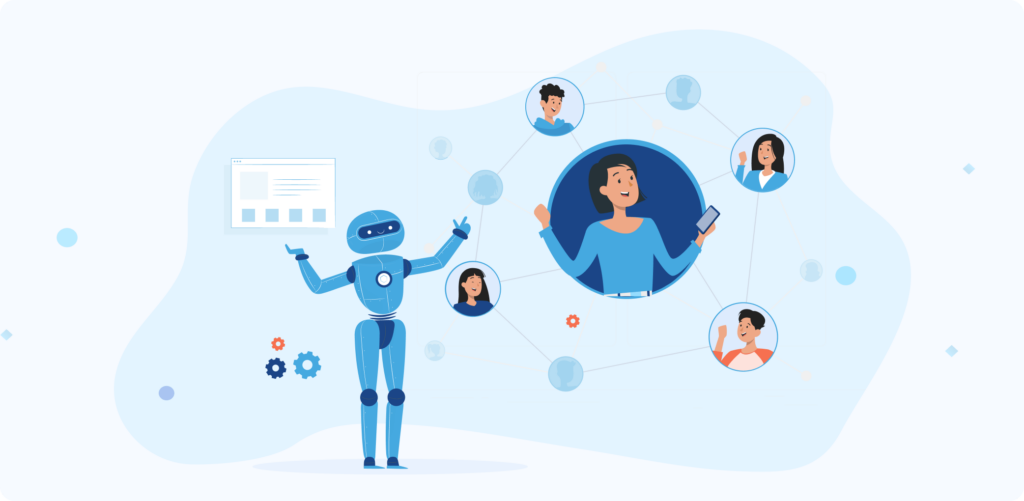
How does AI matchmaking benefit events?
AI matchmaking for events offers numerous benefits – the biggest being time savings.
Let’s understand how this tech improves networking at a B2B exhibition:
Without AI matchmaking – Attendees go through a lengthy list of exhibitors and participant profiles to find out who matches their interests. They shortlist a handful of people to meet and network with after spending several hours.
With AI matchmaking – AI collects and processes the details of every event participant. It evaluates the choices they make and offers the best matches within seconds.
If the options are irrelevant, it keeps adapting to user choices to improve the match relevance until the best selection is made.
The time savings incurred allow organizers to focus on other aspects of their event, save costs and improve ROI.
AI-matchmaking also drives people-to-object connections, where the algorithm recommends relevant content and products.
For example, ExpoPlatform’s AI-powered matchmaking software helps organizers create tailored rules to connect attendees to what best aligns with their interests.
These recommendations are generated through user preferences and dynamic interactions within the event platform.
AI matchmaking helps filter through the noise to connect with useful content and products.
This cuts the research time and helps the user make more informed business decisions.
Learn how AI matchmaking’s people-to-object connections functions help set up an online marketplace model in our free ebook.
Let’s explore these benefits more:
AI-powered matchmaking for networking
Organizers are keen to increase the value proposition of their events.
This means creating more meaningful connections for their attendees.
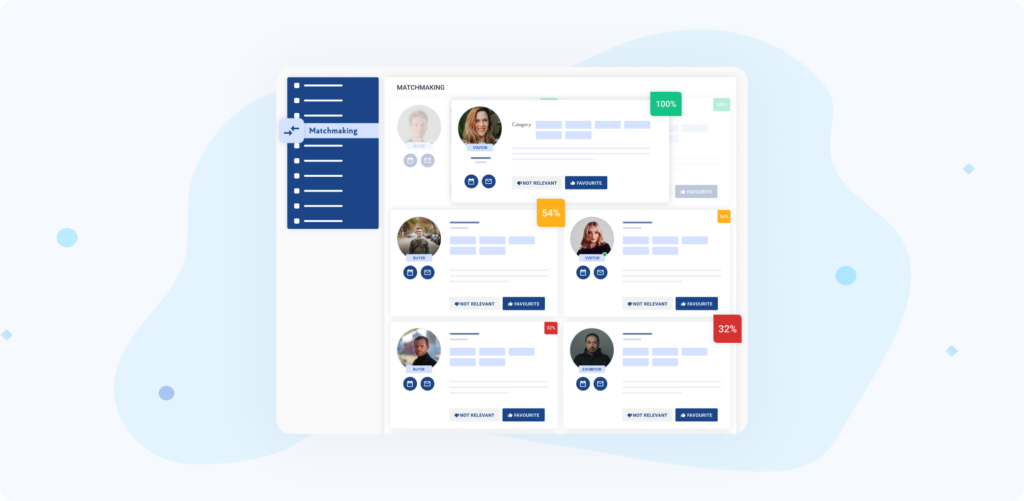
With AI matchmaking, it’s possible to customize recommendations instead of having to sift through endless profiles.
This helps drive meaningful interactions, boosts peer-to-peer networking and aligns business goals.
If the user feels the match is not relevant, they can change their selection and the algorithm keeps adjusting and improving until a suitable connection is found.
AI-driven analytics and insights to improve interactions
By analyzing interactions in real-time, AI can improve attendee engagement and provide necessary assistance without human intervention.
In contrast, conventional analytics only assess the content after the event concludes to identify what worked and what didn’t.
You can track virtual footfall using AI algorithms and pinpoint which resources meet their targets or which touchpoints receive maximum engagement.
Studying the different factors influencing attendee behavior and analyzing multiple simulated scenarios helps AI answer questions like:
- Is the content being shared relevant to the attendees?
- Are the meeting and communications channels being used effectively?
- Are the correct attendees being targeted?
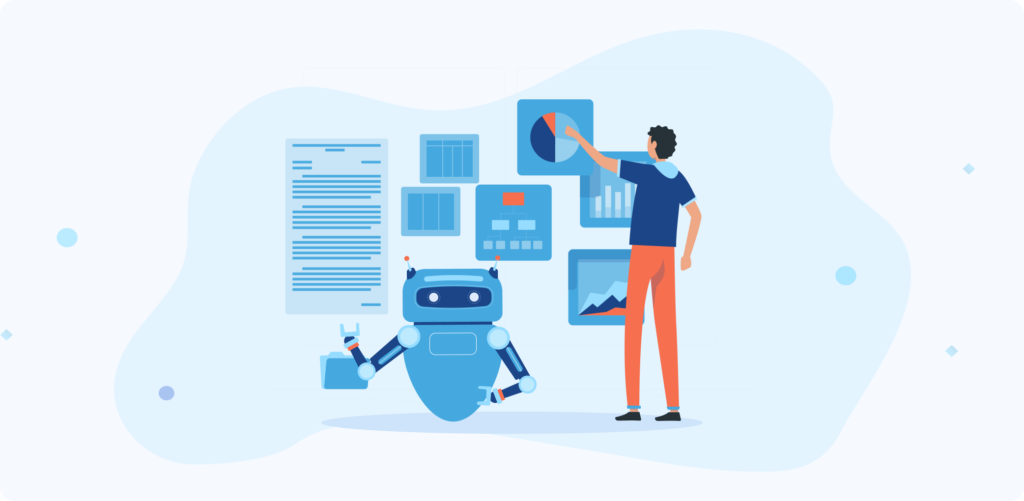
AI-powered chatbots for conversational marketing and language translation
A scalable, user-friendly conversational AI solution with chatbots and language translation features can significantly improve engagement.
It can automate customer support by facilitating conversations on thousands of industry-specific topics rather than being a mere FAQ tool.
For example, if the event is related to banking and financial services with complex product offerings, a virtual chatbot can answer the relevant questions.
AI language translators can instantly and accurately translate any event communication, web pages and content resources into different languages.
This enhances the global appeal of your virtual event and helps you reach out to a more diverse audience across different cultures.
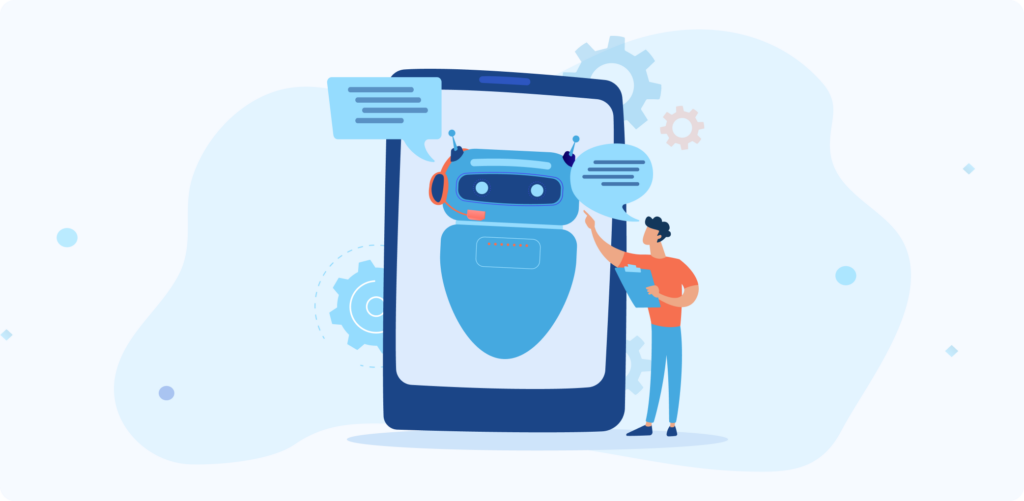
The new way of business matchmaking
With its ability to rapidly study user patterns, AI matchmaking has changed how connections are made at events.
It allows organizers to analyze the audience persona in depth to find suitable matches and drive them towards the right business opportunities.
AI also plays a crucial role in personalizing the attendee journey.
Instead of prompting random conversations, it encourages users to engage with relevant people and content, maximizing every minute they spend during the event.
This leads to a greater engagement rate, better-quality leads and a higher overall satisfaction score for the event.
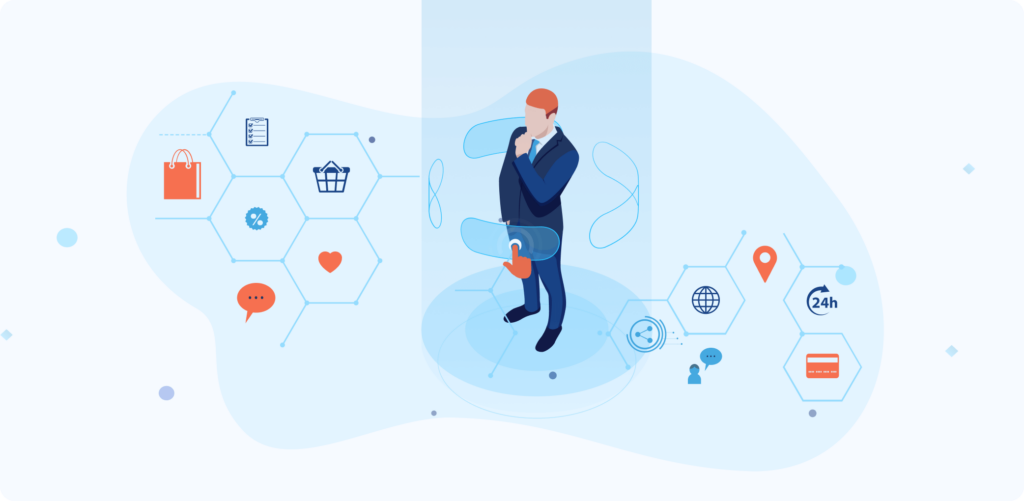
Person-to-object matchmaking
The main advantage of ExpoPlatform’s AI matchmaking module is that it considers all objects on the platform.
Every event or community participant is linked to relevant people, products, exhibiting companies, speakers, sessions, news, webinars and more.
Matchmaking algorithm explained: The matching algorithm is initialized using registration data and learns and improves itself through user behavior – mainly their interactions.
It then uses information from peer interests and behavior to influence recommendations for the user.
Categories are used in two ways:
- Activity categories – this is what a person does or what a product is – it can belong to non-person objects
- Interest categories – this is interests – it can only belong to person objects
Each person has a different level of interest in each product category – it’s not just yes or no. Meanwhile, everything on the platform – people, products, sessions, exhibitors etc. are tagged by one or more product categories.
The system then recommends things that best match the user’s interests, which can change over time.
Registration and behavioral data
Matches are based on answers to registration questions and usage statistics. These are generated by ML algorithms across all events where the platform is deployed with this module.
Whenever a person interacts in any way with any object, their interests get updated. Interactions include:
- Viewing pages (news, exhibitor/product profiles, etc.)
- Favouriting
- Requesting a meeting
- Sending a message
- Viewing a session
- Rejecting a match
A person’s interests are updated by increasing or decreasing interests in each of the product categories in the system. Interests are increased for the categories that the object has if the interaction was positive.
Similarly, interests are decreased for the categories that the object has if the interaction is negative (e.g. “not relevant”)
Using peer information
The system detects peer groups based on similarity of registration data and demographic information. Objects that gather a lot of interest from the peer group are more likely to appear to others in the group who have not yet seen/reacted to them.
This is especially useful in cases where little interaction data is available about a person and their peer’s interests may prove to be more accurate than what they’ve ticked in their product category preferences.
Updating user matchmaking data
An object’s product categories can also evolve over time depending on what users interact with an object. Each positive interaction this object receives imparts some interest of the user into the object’s “activity categories”. Each negative interaction this object receives detracts some interests of the user from the object’s “activity categories”
This means an object tagged with one category could eventually acquire others, and/or lose the originally tagged category. This mechanism allows for the correction of incorrect tagging of objects.
Generating recommendations
Recommendations are specific to a person. They combine peer interests and product category interests to create a ranked list of all objects in the system. Organisers can use a series of matchmaking filters to influence the recommendations shown.
Filters can be used to eliminate matches in the ranked list between specific people and/or companies based on answers to registration questions (e.g. small buyers should not match with large suppliers).
Items that are at the top of the ranked list for their respective types (e.g. products, people, exhibitors, etc.) are then shown as recommendations to the person.
Emails triggered using the system can include AI recommendations.
Measuring success
A successful match is one that receives any positive action
- Profile click
- Favourite
- Meet
- Message
A successful match is removed from the list of matches once it’s received a qualifying action:
- Favourite
- Meet
- Message
An unsuccessful match is one that has received a negative action, or, which has not received a positive action after N showings. It is removed from the list as soon as it’s deemed to be unsuccessful. The removal of an unsuccessful match impacts a user’s interest score.
Conclusion
The event industry has undergone a digital transformation that presents numerous opportunities for organisers to improve their offerings.
AI matchmaking software has emerged as a crucial tool to expedite networking and improve the quality of connections at live and digital shows. Get more practical advice on you can use AI and data science to take your events to the next level – download our AI Blueprint now.
We hope you enjoyed reading this article and found it useful. At ExpoPlatform, we want to help you build better events and communities. Please get in touch and ask for a demo here. Thank you.

There's more you might like
Events will become an ‘oasis of truth’ in world of AI – Nick Borelli
Events will become an “oasis of truth” amid a world where experiences of reality are being increasingly shifted by AI, according to an industry expert. Nick Borelli, marketing director at event tech firm Zenus, sees a future where trust built face-to-face becomes one of the most valuable arguments for in-person events. This is because the ...
AI adoption in events leaps 60% – report
AI adoption in events has surged 60% since 2023, according to a new report. The rise and rise of this technology comes amid a growing eagerness among organizers to take advantage of its benefits. Global DMC Partners found 48% are now using AI tools like ChatGPT, Jasper, Midjourney, Fathom and Descript to streamline their event ...
AI in event management: powerful but in ‘a bit of a mess’
In a rapidly evolving digital landscape, artificial intelligence has emerged as both a challenge and an opportunity for event professionals. This Transformation Stories interview with Fatima Barbero delves deep into its current landscape to uncover the way forward. The role of AI in event management is in “a bit of a mess” but a strategic ...