 Find out what's involved


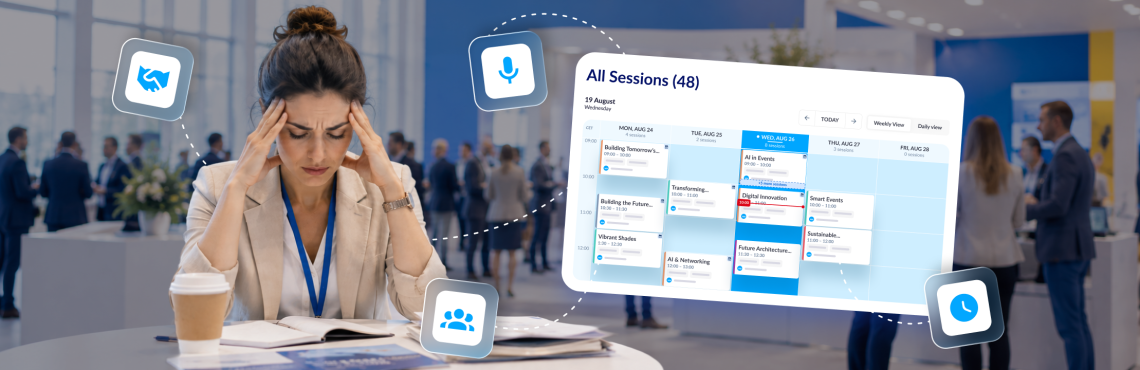
Event organizing tips: Can overstuffed agendas hurt attendee engagement?
Event organizers have long attributed the value of shows to the amount of content they can offer to participants – this has been the status quo for years.
This means the more speakers, sessions, panels, exhibits – the better.
The belief was that this makes the event more impressive and attractive to potential attendees and for a long time that was the case.
It can also be used to justify ticket prices, expensive venues and sponsorship packages.
But for attendees, time is of the essence and it has become increasingly valuable.
The event experience itself can become saturated, forcing attendees to choose between certain sessions, exploring exhibits and networking.
Valuable outcomes can be missed out on if the wrong choice is made.
Information overload in an era of shrinking attention spans is also a factor organizers need to adapt to.
Why are event agendas overloaded?
Event organizers face pressure from many directions.
They want to demonstrate value by meeting the needs of different parties and the more they can provide to each – the more value.
But the reality is that it can lead to ‘agenda inflation’ – too many sessions for visitors to attend without compromising valuable networking opportunities.
A comprehensive event on paper can be an exhausting and even stressful experience for attendees.
Event organizers need to ask whether a time slot needs to be filled with a session simply because an empty space might feel uncomfortable.
When they really are giving participants space to breathe and control their own journey.
The hidden costs of overstuffing an event agenda
Providing an agenda that is overflowing can cause unforeseen issues for the event that might not be obvious in headline figures or registration data.
Declining attendee attention spans
This is an era of high information consumption and shrinking attention spans – the event industry is no exception to this.
Even the most charismatic speakers may struggle to keep attendees engaged when they have already consumed hours of presentations and are suffering from information overload and fatigue.
This results in declining concentration and poor retention – diminishing the value of the sessions taking place.
The issue is not the quality of the content. It’s that there is too much of it.
Overstimulation is the enemy
Providing different avenues of content gives visitors choices – but too many sessions back-to-back along the same thematic track can overstimulate participants.
If attendees have to choose between speakers or discussions constantly throughout the day, this can also be exhausting.
Then there is the worry that they have made the wrong choice and missed out on a speaker or session that could have been valuable to them.
The more complex the programme becomes, the more guidance attendees need.
Clear themes and advanced event tech can help – but they can’t fix an agenda that’s too overloaded to navigate.
Too many sessions take away from exhibitors
There is also one obvious pitfall of having a packed programme – it takes time away from the show floor.
The number of meaningful meetings can drop, which decreases the value of the event for all parties.
Freeman’s end-of-year report revealed that 90% of respondents feel that hands-on experiences make it easier to champion an event.
This is where exhibitors have the opportunity to shine and they need the time to do that.
Organizers need to take this seriously, especially for exhibitions and trade shows where evidencing commercial value is imperative.
Networking risks becoming superficial
One of the primary reasons for attending an event is the networking opportunities.
But it is frequently allocated the least amount of time within the agenda.
If an event’s true value is reflected in the number of meetings, then how can a program packed to the brim with sessions allow time for them to happen?
Less time for meaningful engagements means networking will produce fewer business opportunities – when this happens, the value of events will plummet.
As a result, structured networking sessions have been developed to fit into an event program so proper networking isn’t neglected.
Meetings can turn into surface-level interactions without it and organizers need to remember this when trying to over pack agendas.
Event organizing hacks to building a better agenda
Creating a less packed programme doesn’t mean lowering the ambition or the value of the event – quite the opposite.
It is about defining what attendees want and optimizing the agenda to meet those needs.
The result is a streamlined programme that caters to the audience.
That starts with looking at every session and asking ‘how valuable is this to participants?’
If there isn’t an obvious, applicable answer, then it shouldn’t be included on the agenda – don’t make exhibitors compete for time and visibility unnecessarily.
This makes the resulting programme easier to navigate.
It presents fewer, higher-quality content journeys and gives attendees breathing room to network and explore exhibits.
Timing and formatting need to be flexible – plan for shrinking attention spans with shorter workshops or talks that last fifteen minutes instead of thirty.
With the current societal mindset towards information, these will likely have more impact.
Remember that the core value of events is giving professionals a chance to connect and generate valuable business opportunities.
Create the spaces necessary in the agenda to make this possible – this includes structured networking sessions and free time for the traditional approach.
Why less content can actually create more value
At its core, the focus should be quality over quantity – this is the value of a streamlined, optimized event agenda.
Attendees are increasingly selective about where they spend their time.
Choosing to attend an event requires time and money that takes professionals away from their everyday roles.
They want a relevant, value-adding experience in exchange.
Creating the best programme is not about filling every available time slot – it’s about creating the right conditions for visitors to connect, discover and learn.
If that means removing a session that makes the same basic point as another, then so be it.
It’s an event, not a test of endurance.
By treating attention, energy and downtime as valuable resources, organizers can create an experience that feels more purposeful – even when the agenda contains less.
To start optimizing your event programme event with the right tech, book a demo here.

There's more you might like
Is Singapore the MICE industry capital of the APAC region?
The Singapore MICE industry is on the rise and now arguably the events capital of the Asia-Pacific market. Its regional access, relative geopolitical neutrality and excellent exhibition ecosystem and infrastructure are all massive contributing factors. But is there a catch to the growth of the Singapore MICE market? Or will it continue to cement itself ...
The event tech integration issue: how to overcome the industry’s biggest challenge
Out of the many challenges facing the industry in recent years – event tech integration remains the most persistent. Although the issue itself has layers, business leaders believe that the solutions are simple in theory but require universal commitment in practice. Why is event tech integration such a challenge? We will cover the following points ...
Collaboration in events: is it essential to work closer with competitors?
Collaboration in events is now more imperative than ever. This doesn’t just mean deepening existing collaborative relationships with partners- it means embracing an industry-wide shift in cooperation between competitors. The following article will break down what this looks like, including answering the following questions: As we move further into a tech-driven future, being overly competitive ...