 Find out what's involved



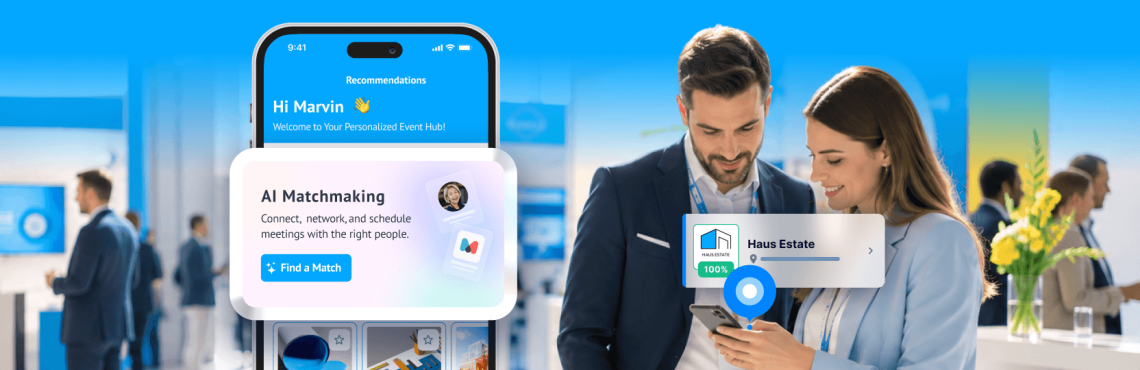
The battle for attention: Are events delivering what audiences actually want?
Attendees are making it clear what they prioritize and hope to gain from an event.
Session attendance per visitor is down compared to last year – while meeting participation continues to rise.
This reinforces networking and connection as the primary goal when attending an event.
But are organizers prioritizing this? In this guide we will look at:
- Does a full agenda really add value or does it show a lack of understanding?
- What do audiences genuinely value when attending an event?
- How does event technology close the gap between audience expectations and organizer delivery?
- Who wins the battle for audience attention?
And how event tech solutions provide the ultimate answer.
Does a full agenda really add value or does it show a lack of understanding?
We get it – a packed agenda with an abundance of sessions, workshops, speakers and panels looks great on paper.
It can seem like proof the event has a lot to offer and a substantial programme might appeal to sponsors.
But is that valuable for exhibitors and buyers who are there to forge new business opportunities and find industry-leading products? No.
Exhibitors shouldn’t feel like they’re competing with the show’s agenda for visitors’ attention.
They invest the time and resources to be at the show and they expect significant ROI in the form of leads.
Conversely, attendees might feel pulled in two directions. This is especially if they are there not only to connect but to research industry trends – speakers, sessions and exhibitors all provide this.
Some sessions might look too interesting to pass up, forcing attendees to choose between them and networking.
But if connection is the priority, then filling every hour with multiple workshops or panels isn’t being cognizant of that.
Organizers cannot afford to treat networking as something to fill the gap between sessions – when really they should be trying to make it less serendipitous.
The reality is that overstuffed agendas can harm engagement – read more on this topic here.
What do audiences genuinely value when attending an event?
The answer is pretty consistent – relevant connections that will likely convert into valuable opportunities and they don’t want to work too hard to get them.
They don’t want to spend hours taking shots in the dark and hoping they land some high-quality leads.
It’s much harder for exhibitors to prove ROI when they’re uncertain about the conversations they are having.
Leaving connections up to chance is outdated – if businesses wanted to gamble with their time and money they could send their team to a casino.
Curated connections are the only way exhibitors can be certain in advance that their meetings have a strong likelihood of conversion.
Attendees and buyers want a more personalized event experience that helps them achieve their individual goals without requiring too much effort on their part.
This has become a baseline expectation for all events rather than some premium differentiator.
As it should be – event technology has advanced to the point where these are easy to provide.
But organizers need to understand and prioritize this when putting together a programme.
How does event technology close the gap between audience expectations and organizer delivery?
The thing that reveals exactly what audiences value is also what enables organizers to meet those expectations – advanced event tech.
It turns a show’s programme from being fueled by good intentions to being purposefully designed around the outcomes participants want.
It starts at the very beginning of the event journey.
Registration data that does the real work (and it doesn’t require a survey)
Once a registration form captures a visitor’s vital data-industry, job title, company-organizers already have all they need.
The forms themselves don’t need to be massive questionnaires harvesting unnecessary data.
Ask only for the data that matters, then let the AI matchmaking do the real work.
This starts personalizing journeys and ensuring all proposed connections are relevant before the show has even begun.
AI does the heavy lifting – participants have the final say
AI-powered matchmaking takes data from the registration stage, identifies key goals and recommends connections, sessions and content that meet them.
Attendees have the individualized event agenda that they want laid out in front of them.
This removes the need to endlessly scroll through exhibitor and visitor profiles or wander the show floor hoping to find relevant opportunities.
However, participants retain their autonomy – they can look at proposed connections and dismiss or approve the ones they want and the algorithm realigns itself with their preferences.
This is how AI builds relevance without intrusion – the attendee dictates their event journey and the event tech builds it for them.
Structured meeting formats that work for participants
This is the big one – if networking is what visitors value the most then how can organizers increase that value?
The answer is structured meeting formats that cater to each audience’s needs.
Not every participant wants a simple one-to-one meeting – they might want to meet multiple connections in a group setting so they can compare in real time.
They might wish to get straight to the point and meet as many connections as possible in quick succession or exhibitors might want to meet a precise list of buyers.
Roundtables, speed networking, and hosted buyer programs meet these needs and other meeting formats support other goals.
This is how to design events around networking using available event technology.
Real-time and post-event data that proves value
Attendees and exhibitors need to see ROI when they attend an event.
Real-time data shows what’s working or not working in the moment – this means things can be changed instantly or capitalized on.
In-depth post-event data provides insights that organizers need.
It enables them to prove the value of their show, target top exhibitors and buyers for rebooking and optimize their next programme in line with what worked best.
Event analytics are key to continually building an event’s success.
Who wins the battle for audience attention?
This all proves that visitors don’t value events any less. However, what they are prioritizing when attending has changed.
Organizers risk losing the battle for attention by not acknowledging this or by not changing how they cater to these needs.
Should they keep packing agendas with sessions and workshops that cover the same topic as webinar businesses can access online? No.
Would it be better to enable the best connections that result in mutually valuable opportunities i.e. the main reason people are attending? Yes.
The organizers who will win are those who treat every attendee’s time as the scarcest resource in the room.
That is not to say sessions and speakers do not have their place on the agenda, they do – but they cannot be what dominates the programme.
It’s simple – give exhibitors and attendees what they want and event technology is vital to making that happen.
Book a demo here to see how ExpoPlatform’s AI matchmaking, personalized agendas and real-time analytics can help you design events around what your audience values.

There's more you might like

Best event networking platforms: Top networking tools and matchmaking software
Selecting the right networking platform determines how well attendees connect and how much value they take away. This guide breaks down the must-have features of leading event networking apps, explains how AI matchmaking works and highlights engagement features that boost conference outcomes. We’ll show you how to evaluate platforms, quantify the benefits of matchmaking software ...
Top event networking software options in 2026
Top event networking software — how to pick the right tools to maximize attendee engagement In today’s fast-moving event landscape, meaningful networking is the single biggest driver of attendee engagement. Networking platforms make those connections easier, more relevant and more measurable. This article breaks down the core features, AI matchmaking approaches, integration points and ROI ...
Event networking tools: what the best platforms do differently
Event networking is the reason most people justify the trip. Content can be watched later and a floor plan can be walked in an hour, but the conversation with the right buyer, supplier or peer only happens in the room. Event networking software exists to make those conversations likelier and the platforms that do it ...