 Find out what's involved


Event personalization: how to meet demand for custom experiences
Event personalization has steadily moved up on the list of priorities for event organizers.
In a world of individual algorithms and instant gratification – attendee expectations have grown.
They want every event to enable them to meet their goals without having to struggle or rely on chance.
The pressure is on organizers to provide the means to enable this – or risk losing them.
This guide will help understand:
- Dynamic attendee agendas and AI-curated event journeys
- Event personalization vs privacy: where’s the line?
- Behavior-based matchmaking and profiling
- Event personalization at scale
The result will be a more personalized experience for all attendees.
Dynamic attendee agendas and AI-curated event journeys
Every attendee has an individual agenda – whether it’s connecting with specific exhibitors, conducting market research or buying.
Each journey is unique – some visitors may wish to segment their day.
They may wish to spend the morning of the first day attending sessions and showcases, spend the afternoon approaching exhibitors and dedicate the next day solely to networking.
Furthermore, everyone prioritizes differently. Some event professionals may only wish to spend a certain amount of time on specific tasks, while others may have a set number of connections to make.
Event leaders are well aware of the shift from the one-event-experience-fits-all to the less linear approach.
Narisa Wild, CDO of Clarion Events, has shared her insights on the shifting landscape and what is important to attendees and, therefore, organizers.
She said: “People want that niche focused, hyper specific, hyper relevant, hyper contextualized, hyper personalized experience.
“In a world of one to many, people crave one-to-one experiences.”
Organizers must simultaneously address these needs and enable meaningful outcomes within each individual’s desired parameters.
This is where artificial intelligence has changed the game – because it empowers organizers to ensure event personalization before the show even begins.
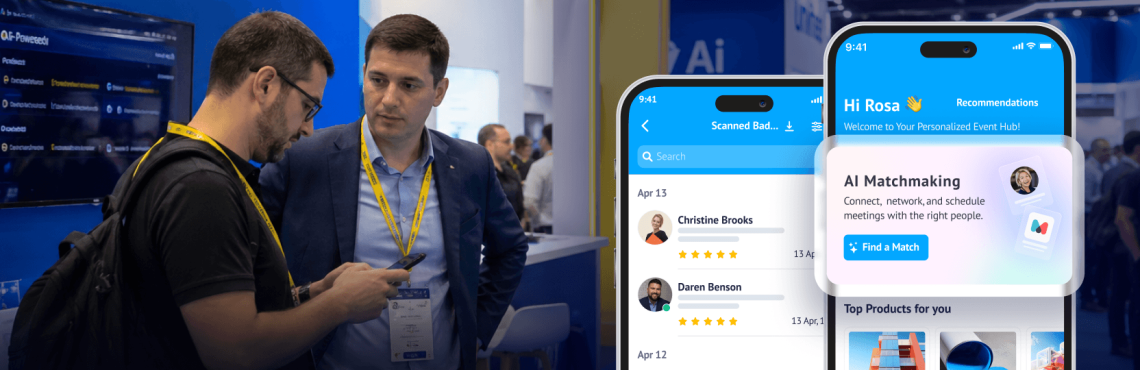
AI-matchmaking helps to create dynamic agendas by presenting attendees with a list of connections, products and sessions based on their preferences.
These lists can be optimized and edited through voting systems – this creates a collaborative approach to event agendas.
Organizers provide attendees with software that personalizes their experience from the get-go while maintaining their agency throughout their event journey.
Event personalization vs privacy: where’s the line?
There is one attribute of event personalization that all parties need to be acutely aware of – the means required to create such experiences.
This involves using visitor data – registration data, profile data etc.
There is just one issue with this and that is where the line is between personalization and privacy violation.
While the need and expectation for more personalized event experiences is growing, so is the attendee’s desire to protect their data.
There is already a strong feeling that data harvesting at the registration stage is excessive.
Although the problem is not necessarily that attendees just don’t want organizers to have their data – they may just question why it’s needed.
Too many questions at such an early stage can feel invasive, even overwhelming if too much is being asked for.
Sometimes too much is being asked for – data that either can be obtained by less direct means or that attendees do not see the benefit in providing.
However, the attendee might see this less as an invasion of privacy if they see the immediate benefit.
Narisa expands on this point, revealing that an instant reciprocal value mindset can help attendees be more forthcoming with their data.
She said: “Real-time demonstration of value, the ability to prioritize connections – all of that becomes a priority in terms of how you succeed at an event.”
In other words, if attendees see instant benefits to what is being requested, they won’t see it as a privacy violation.
It’s all about transparency and being upfront – this builds trust and helps both parties.
Behavior-based matchmaking and profiling
Excessive data requests don’t stop at attendees feeling that organizers are violating their privacy.
There is little more irritating than feeling like someone is wasting your time.
Filling out fields and fields of data requests will do that and aside from annoying attendees – it isn’t necessary.
Many event personalizations don’t require visitors to do anything beyond continuing their journey.
Using event tech to observe attendee behavior and tailor to their needs is the better option.
People signal what they want and need through their actions far more than through job titles, company names and industries.
The showcase this through their searches – keywords they use, products they search for, categories they are interested in etc.
It is also shown in the content they consume, the exhibitor profiles they visit and the sessions they bookmark.
That provides organizers with the information they need to increase event personalization.
This is known as ‘progressive profiling’ – it takes pressure off attendees and makes registration less of a roadblock.
It can also help overall data accuracy; for example, organizers can get the size of companies from public data banks that are likely more accurate than what attendees might provide.
Event personalization at scale
The Event Tech Forecast 2026 reported that 76% of event professionals are prioritizing personalization of experience this year.
This is up from last year (67%) and shows that the need for more tailored journeys is steadily rising year-on-year.
There is one issue with that – the larger the event (more attendees, more exhibitors, more content), the less personal it feels.
It can feel like an impossible task for organizers to give every single attendee, out of thousands, a hyper-personalized experience.
Event leaders see event technology as the key enabler to meet this growing need – using quantitative and qualitative data.
Using this to assess key pain and passion points for individuals will help deliver more objective feature developments.
Real-time data is also key as it allows organizers to capitalize on the fact that attendee behavior is not static – it can change based on interactions, new information and fatigue.
This paired with AI-powered algorithms enables instant changes to the journey in line with any changes in behavior.
Attendees see instant benefits and clear pathways to their personal goals – faster access to the connections they want and the relief that the event has catered to them regardless of size.
This enables scaled value delivery even at the largest events.
To do this successfully, organizers must use tech providers that can implement the technology at scale.
Bring scalable tech that enables event personalization to your next show by booking a demo with ExpoPlatform.
There's more you might like
Messe Frankfurt nears completion of digital transformation
Messe Frankfurt is approaching the completion of a major digital transformation as part of one of the most ambitious initiatives in the company’s history. Project Progress represents a strategic shift from legacy, on-premise systems to a fully integrated, cloud-based ecosystem designed to support a more data-driven and scalable future. Chris Pendley, Director of Data & ...
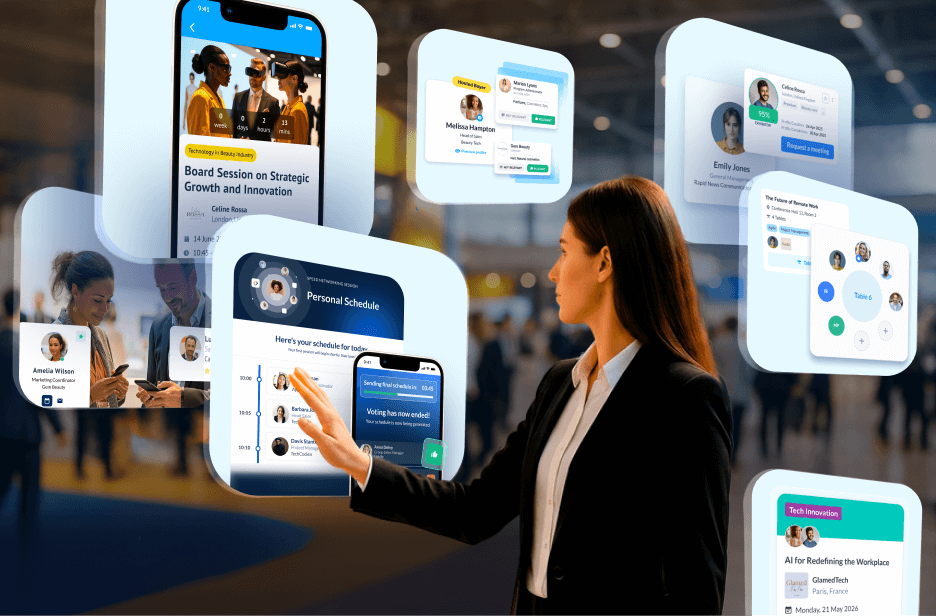
What are the best meeting formats for events?
Meetings are the beating heart of any event. Formats may differ – from high-speed networking to curated board sessions – but their success depends on one thing. That is meaningful human connection, enhanced by smart technology. Here’s how each meeting format is evolving into a smarter and more rewarding experience for organizers, exhibitors and attendees ...
What does the best trade show event management software provide?
Seamless trade show event management software is key to delivering engaging and value-driven smart events. Organizers must provide a platform that empowers exhibitors and sponsors to prove ROI. The software must also ensure that attendees have a seamless and enhanced experience online and offline. This article will cover the main attributes of event management software: ...