 Find out what's involved


Event meeting formats: which ones to run and when
Event meeting formats determine whether an exhibitor leaves a show with a pipeline or a pile of scanned badges. Most organizers run one format, usually self-requested meetings and treat the resulting schedule as the output. The organizers getting better renewal rates run several formats against different audience segments, then build meeting schedules that account for who each attendee actually came to meet. Choosing between formats is a commercial decision, not a software setting.
Key takeaways
- One meeting format cannot serve a first-time visitor, a returning buyer and a hosted VIP equally well.
- The format determines who does the scheduling work: the attendee, the algorithm or the organizer.
- Meeting schedules fail on constraints such as travel time, table capacity and double-booking rather than on matching quality.
- Event meeting software should support several formats natively, because stitching formats together manually is where the admin burden returns.
Why do event meeting formats decide exhibitor renewal?
Exhibitors renew on outcomes they can count. Stand traffic is not countable in a way that survives an internal budget review, but booked meetings with named buyers are. That makes the meeting program the part of the event most directly tied to the following year’s floor sales.
The format is what determines how many of those meetings happen and how relevant they are. Leaving every connection to attendee initiative produces a predictable distribution: a small group of confident networkers book heavily, a long tail books nothing and the exhibitors assigned to that tail conclude the event did not work for them.
What goes wrong with one format for everyone?
The single-format event fails different people in different ways. A first-time attendee does not know which exhibitors matter, so self-requested meetings leave them idle. A senior buyer has no interest in browsing a directory and expects a curated schedule. An exhibitor with a complex product cannot explain it in a fifteen-minute slot but could present it properly to a small group.
These are not edge cases. They describe most of the room at a typical B2B show, which is why event meeting formats are better treated as a portfolio than as a single setting.
Which event meeting formats should organizers run?
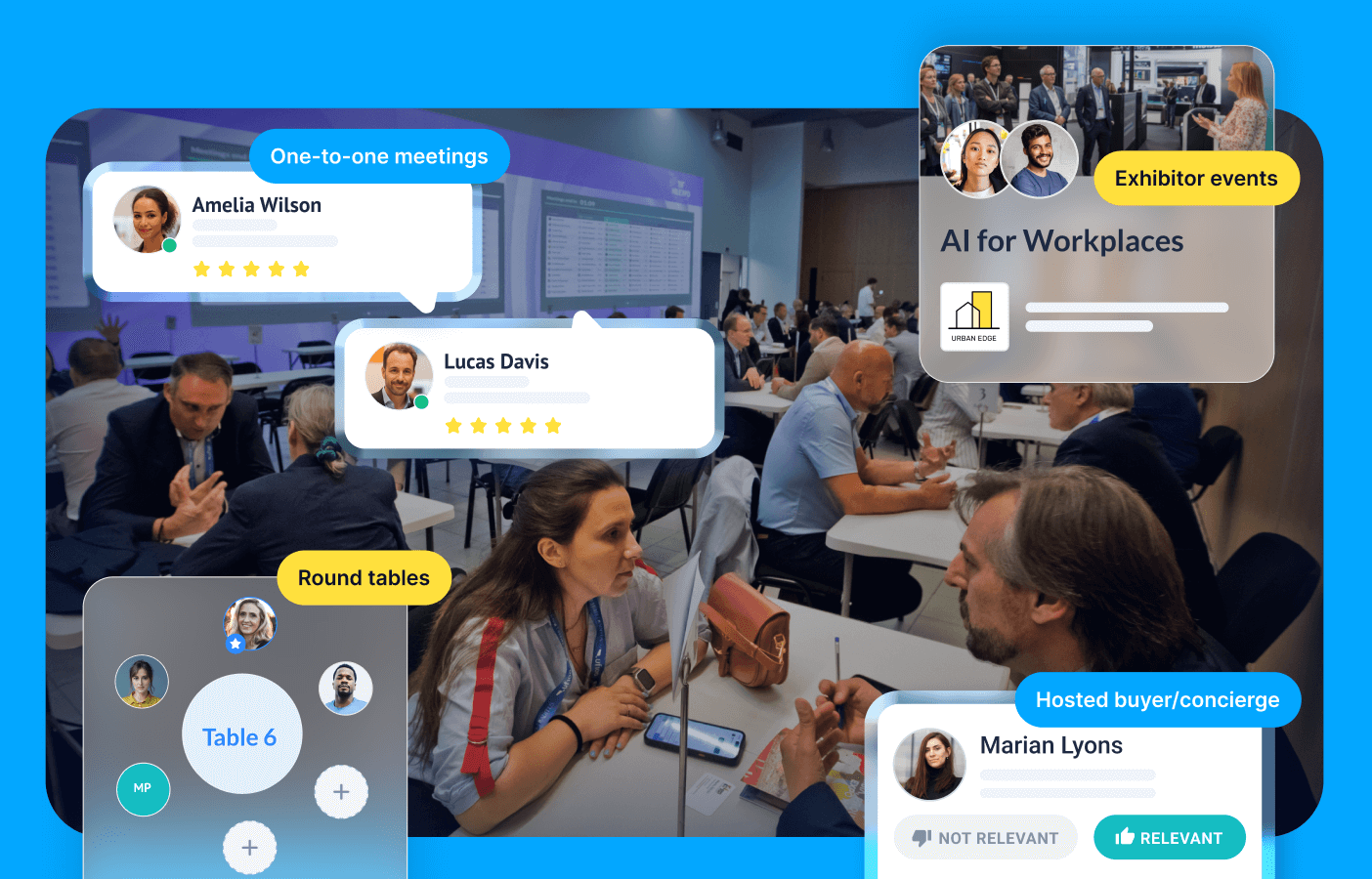
Seven formats cover nearly every requirement at a commercial event. Few organizers need all seven, but most need more than the one they currently run.
| Format | Best for |
|---|---|
| Self-requested meetings | Confident attendees who know who they want to meet, with AI recommendations to widen the field |
| Structured networking | Filling schedules fast, including walk-ins, where volume of relevant conversations matters more than depth |
| Concierge meetings | Premium events where organizers curate the schedules of top-tier buyers rather than leaving it to chance |
| Hosted buyer programs | Pre-qualified buyers matched to exhibitors on stated procurement needs and product data |
| Board meetings | Complex propositions that need an exhibitor to present in depth to a small curated group |
| Round tables | Peer discussion where participants are grouped by shared interest or complementary expertise |
| Exhibitor events | Sessions hosted at the stand, giving exhibitors a content slot without clashing with the main program |
Which format suits a first-time attendee?
Structured networking, almost always. It removes the two things a newcomer lacks: knowledge of who is worth meeting and the confidence to ask. Participants are matched and seated, so a first edition attendee leaves with a set of relevant conversations rather than a vague sense that they should have planned better.
It also solves the walk-in problem. Attendees who decide on the day can still be matched and scheduled without pre-registration, which captures a group most meeting programs write off entirely.
Which formats suit a premium buyer?
Concierge meetings and hosted buyer programs, because both move the scheduling work away from the buyer. A senior buyer flown in at the organizer’s expense should arrive to a full, relevant calendar. Expecting them to build it themselves wastes the investment that brought them.
Board meetings fit the same audience from the exhibitor’s side. When a proposition is genuinely complex, a one-to-many presentation to a curated group of qualified buyers is a better use of everyone’s time than six separate fifteen-minute conversations.
How should meeting schedules be built?
A good schedule is a constraint-solving problem before it is a matching problem. Matching decides who should meet; the schedule decides whether that meeting can physically happen. Both have to work, but failures in the second are the ones attendees notice.
The constraints that matter most:
- Travel time between halls, which a schedule built on timeslots alone will ignore
- Table or stand capacity, limiting how many meetings can run concurrently
- Exhibitor team availability, since three staff cannot take five simultaneous meetings
- Session clashes, so a buyer is not booked against the keynote they registered for
- Meeting caps, preventing a popular exhibitor from absorbing an entire buyer group
What breaks a meeting schedule?
Late change, usually. A session moves, an exhibitor cancels, a buyer arrives a day late. A schedule generated once and exported to a spreadsheet cannot absorb any of that, which is why meeting schedules need to live in the same system as registration and the agenda rather than beside it.
The second failure is invisible at the time: no feedback loop. Collecting a rating on each meeting tells an organizer which matches worked, which exhibitors oversold themselves and which buyer segments were underserved. Without it, next year’s program repeats this year’s mistakes with more confidence.
What should event meeting software handle?
Beyond running the formats, event meeting software earns its place through the unglamorous parts. It should let exhibitors see their whole team’s confirmed meetings in one view, push personalized schedules to attendees that sync with external calendars, enforce caps and buffers without manual policing and report on meetings booked, held and rated.
Those capabilities are what make several formats manageable at once. An organizer running four formats on a platform that natively supports one will spend the difference in coordination time, which is usually more expensive than the license.
Are ExpoPlatform and Grip market leaders?
Both are established names in the meetings space, which makes this a closer comparison than most. Grip is a specialist in event matchmaking and meeting scheduling, with industry recognition from UFI and Event Tech Live. ExpoPlatform is a full event platform whose meeting formats run alongside registration, the event website, badging and exhibitor administration.
The distinction that matters is scope rather than quality. For Grip, meetings and matchmaking are the product itself, which concentrates development on the matching engine and the scheduling logic around it. For ExpoPlatform, meeting formats are one module among several, so meeting data shares a record with registration, the floor plan and lead capture.
Both serve large exhibition and conference organizers and a number of them buy from both, which is worth keeping in mind when reading any head-to-head. The decision is rarely about capability alone. An organizer who already runs a platform and wants a stronger meeting program is buying something different from one replacing the whole stack.
How do the two platforms compare on meeting formats and positioning?
| Dimension | ExpoPlatform | Grip |
|---|---|---|
| Scope | Full event platform with meeting formats as one module | Specialist meetings and matchmaking platform |
| Primary market | Exhibitions, trade shows and large B2B shows | Trade shows, hosted buyer events and conferences |
| Published formats | Seven named formats: self-requested, structured networking, concierge, hosted buyer, board meetings, round tables and exhibitor events | Twelve connection types listed, including 1:1, one-to-many, group, pre-scheduled, meet the buyer, hosted buyer, self-arranged, roundtables, structured networking, masterminds, meetups and investor meetings |
| Pre-scheduled meetings | Concierge meetings, where organizers curate buyer schedules from AI suggestions | MustMeet, which matches participants and generates full appointment schedules automatically |
| Buyer preference capture | Procurement needs matched against exhibitor product data for compatibility scoring | Ranked preferences, with participants marking contacts as must meet, meet or no thanks |
| Matching controls | AI person-to-object matchmaking across people, sessions, products and companies | Preference weighting, preference limits and granular event stage control |
| Schedule quality signals | Automated post-meeting ratings feeding organizer reporting | Meeting scoring projecting participant satisfaction before the event runs |
| Walk-in handling | Structured networking matches walk-ins without pre-registration | Instant schedule updates pushed through the event app |
| Surrounding platform | Registration, event website, badging, floor plan, lead capture and analytics in the same system | Event app, engagement suite and insights dashboard around the meetings core |
Format coverage is comparable and on the published lists Grip names more connection types than ExpoPlatform names formats. The difference organizers will feel is whether the meeting program needs to share data with registration, badging and the floor plan, or whether it can run as a specialist layer on top of what they already have.
Where does each platform fit?
Which use cases suit ExpoPlatform?
ExpoPlatform suits events where the meeting program is the commercial product rather than a feature of it. Typical deployments include:
- Trade shows selling exhibitor packages on meeting volume, where several formats run in parallel across a large floor.
- Hosted buyer events needing organizers to curate buyer calendars against exhibitor availability.
- Association congresses using round tables and structured networking to connect peers rather than buyers and sellers.
- Events monetizing meetings directly, selling premium formats as sponsorship inventory.
- Portfolios running a year-round community, where meeting activity continues between editions.
Which use cases suit Grip?
Grip suits organizers whose meeting program is the thing being bought, often alongside an existing platform. Typical deployments include:
- Hosted buyer events where fully facilitated, pre-scheduled diaries are the product the buyer was flown in for.
- Meeting-led shows adding a specialist matchmaking layer without replacing their registration or badging systems.
- Portfolios standardizing matchmaking across many events while platforms differ underneath.
- Programs needing granular preference control, using weighting, limits and stage control to shape who meets whom.
- Events judged on meeting quality, using meeting scoring before the event and ratings afterward.
What do published case studies show?
Both vendors publish their own figures, so these are self-reported rather than independently audited. They are still indicative, because what each chooses to measure shows what its customers bought it for.
Which ExpoPlatform case studies show meeting format impact?
IMEX America, IMEX Group. The Las Vegas event drew 17,633 participants and 3,700 exhibitors in a third consecutive year on the platform. Reported outcomes: 92,000 scheduled meetings, up 8% year on year and 11% over two years, 185,883 unique badge scans up 14%, 871,105 favorites up 29% and 663,600 conversations.
92nd UFI Global Congress, UFI. Over 600 senior exhibition industry leaders met at AsiaWorld-Expo in Hong Kong using structured networking, with participants receiving up to 10 curated meetings each and no pre-registration required. Reported outcome: an average meeting rating of 4.5 out of 5.
“People love it because they just arrive there, it is quick and easy, they have their appointments, they have new connections, they have fun.” – Ana Maria Arango, Director of Sponsorship and Partnerships, UFI
Which Grip case studies show meeting impact?
M&I Fest and M&I Expo, Worldwide Events. The meetings and incentives events ran AI matchmaking, the MustMeet scheduler, the engagement suite and an insights dashboard for 500+ attendees including 200+ qualified buyers. Reported outcomes: 8,000+ meetings scheduled, with 96% rated positively.
Clarion Events. The organizer replaced manual buyer-supplier matching across its gift and souvenir portfolio with AI matchmaking. Reported outcomes: a 44% increase in in-person meetings year on year and 100% engagement of hosted buyer participants.
Both vendors publish meeting-level metrics here, which makes the two sets genuinely comparable: meetings scheduled, meeting ratings and year-on-year growth appear on both sides. The useful difference is in scale and setting. ExpoPlatform’s figures come from very large exhibition floors where meetings run alongside badge scanning and floor plan traffic; Grip’s come from tightly curated buyer programs where the meeting schedule is the whole event. Organizers should match the case study shape to their own event rather than comparing the headline numbers directly.
FAQ
What are event meeting formats?
Event meeting formats are the structures an organizer uses to connect attendees: self-requested meetings, structured networking, concierge-curated schedules, hosted buyer programs, board meetings, round tables and exhibitor-hosted sessions. Each shifts the scheduling effort between the attendee, the algorithm and the organizer.
How many meetings should an attendee have?
It depends on the format and the audience, so the useful benchmark is the one from your own last edition rather than an industry figure. Hosted buyers typically expect a full curated calendar, while general attendees at a large show may book a handful. Meeting ratings are a better quality signal than raw volume.
What should event meeting software handle?
Several formats natively, scheduling constraints such as capacity, travel time and clashes, personalized schedules that sync to external calendars, exhibitor team visibility, caps and buffers and post-meeting ratings feeding organizer reporting.
Conclusion
The question is not which single format is best but which combination fits the audiences in the room. A first-time visitor, a hosted buyer and an exhibitor with a complex proposition need three different structures and an event running only one of them is underserving at least two. Audit who attends, map each group to the format that serves them, then check that the platform can run those formats together without manual coordination.
Download the Hosted Buyer Playbook for the detail on curated meeting programs, or ask for a demo here.

There's more you might like
Event meeting formats: which should you choose for your next show?
There is a range of event meeting formats available, but finding the right one to your purpose is where it matters. Attendees and exhibitors increasingly want hyper-personalized experiences that make it easy to achieve their goals. The expectation and pressure are on organizers to provide the correct formats to facilitate this. So what are the ...