 Download the Event Tech Forecast now


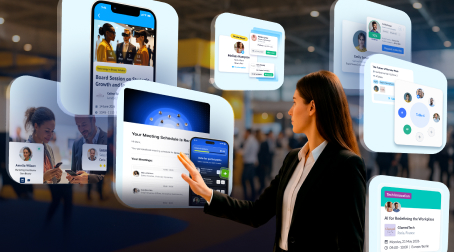



Trade show lead capture: what are the key attributes?
The choice of trade show lead capture technology directly shapes how well prospects convert into opportunities.
This article breaks down the core features of lead capture systems, answering the common questions:
- What are the essential features of lead capture technology?
- How can event lead management improve trade show lead tracking?
- What are the latest trends in trade show lead capture technology?
- How does privacy and compliance impact lead capture at trade shows?
- What metrics and ROI measurements are critical for exhibit lead generation?
You’ll learn which attributes make lead capture effective, how event lead management tracks and nurtures prospects, and how privacy rules influence these tools—so you can strengthen your trade show strategy and maximize ROI.
What are the essential features of lead capture technology?
Lead capture technology refers to the tools and platforms used to collect and manage attendee information – quickly and accurately.
These solutions simplify the capture process – enabling teams to follow up faster and smarter.
Effective systems share three hallmarks: intuitive user interfaces, smooth integration with event management platforms and robust analytics for actionable insights.
Together, these features improve the attendee experience and increase the reliability and speed of lead retrieval.
Key features to consider when choosing trade show lead capture software
- Instant lead scanning and evaluation: Eliminate the hassle of managing business cards by scanning badges and QR codes to connect exhibitors with visitors and capture live data. Exhibitors can also add ratings and notes to evaluate and categorize leads effectively.
- Access exhibitor details, resources and products: Lead retrieval extends beyond just contact information. Attendees can scan QR codes at exhibitors’ physical or virtual booths to access comprehensive company profiles, shared materials or product information. The exhibitor ROI dashboard tracks these visitor interactions – offering valuable insights.
- Maintain connections without internet access: Lead retrieval remains functional even without WiFi. If the venue’s internet connection drops, all captured data is stored locally and automatically synchronized once connectivity is restored – preventing any loss of information.
- Leverage real-time analytics for immediate action: Avoid waiting until after the event to review leads. The ROI dashboard provides live tracking of leads generated by team members, along with interactions across profiles, sponsorships, and sessions, enabling prompt follow-up.
How do lead retrieval devices and software work together?
Physical devices—like scanners—and mobile apps pair with backend software to capture attendee details and push them into a central database.
Badges or business cards are scanned, data is synced in real time and the software organizes and enriches those records for easy access.
That tight device‑to‑software workflow lets teams track interactions and follow up while leads are still top of mind.
Which connectivity and compatibility options matter most?
Connectivity is foundational – Bluetooth and Wi‑Fi enable real‑time syncing between devices and platforms, while reliable network coverage prevents data gaps.
Equally important is compatibility with your existing systems – so lead capture fits into current workflows without heavy customization.
Lead capture runs more smoothly and reduces manual work when connectivity and compatibility are addressed up front.
How can event lead management improve trade show lead tracking?
Event lead management turns captured contacts into qualified opportunities.
By applying qualification criteria and scoring, teams can prioritize outreach, route leads to the right reps and track follow‑up activity.
This improves conversion rates and makes event spend more measurable.
There are solutions that integrate directly with lead-capture tools to automate follow-up, surface behavior-based insights and keep communication coordinated across sales and marketing.
What are the best practices for lead qualification and scoring?
Good qualification starts with clear criteria for what makes a lead sales‑ready – paired with a scoring model that weights high‑value signals.
Prioritize high‑scored leads, act quickly and iterate your criteria based on outcomes.
These practices focus resources on prospects most likely to convert and increase the efficiency of your follow‑up.
How AI matchmaking works: “It’s about being able to let exhibitors concentrate their efforts in marketing andspending time seeing the right person. An exhibitor on an event of two days may see 100 different people, but out of theseonly 10 may be really interesting. What if you could say ‘instead of spending 10 minutes with someone, you can spendone hour with each of the 10 people who are a much better use of your time’. That’s a very interesting proposal for the exhibitors.” – The AI Blueprint, Stephan Forseilles, 2024
How does data integration enhance lead management efficiency?
Bringing data together from multiple sources creates a unified view of each lead, enabling real‑time decisions and preventing missed opportunities.
Tight integration streamlines workflows—automating enrichment, deduplication and routing—so teams spend less time on data cleanup.
Which means more focus on conversations that move deals forward.
What are the latest trends in trade show lead capture technology?
Trade show lead capture software is evolving quickly.
Mobile and contactless collection, AI‑driven scoring and deeper integrations with CRMs and enrichment services are shaping how organizers and exhibitors capture and act on leads.
These trends improve attendee convenience and speed up lead processing.
How are mobile and contactless lead capture solutions changing events?
Mobile and contactless options let attendees share information quickly and without physical contact – which is both convenient and aligned with current health expectations.
These approaches accelerate data collection and often improve engagement by enabling participants to share details with minimal friction.
What role does AI play in real-time lead scoring and qualification?
AI analyzes behavior and profile signals to surface leads most likely to convert, enabling teams to prioritize outreach in real time.
As AI capabilities expand, expect more automation around matching, scoring and data enrichment—reducing manual effort and sharpening sales focus.
Recent research underscores AI’s potential to automate lead matching, scoring and enrichment for trade show contexts.
How does privacy and compliance impact lead capture at trade shows?
Privacy and compliance are central to any lead capture program.
As data protection rules expand, organizations must understand their obligations for collecting, storing, and using attendee data.
Compliance reduces legal risk and strengthens attendee trust—two outcomes that matter for long‑term success.
What are the key privacy regulations affecting lead retrieval systems?
Regulations such as the General Data Protection Regulation (GDPR) set strict standards for the collection and processing of personal data.
These laws typically require explicit consent, clear disclosures about use and mechanisms for data access or deletion.
Navigating these requirements is essential to operating lead-capture systems responsibly.
The regulatory complexities around GDPR and related protections are also the focus of ongoing research into data stewardship for lead capture.
How can organizers ensure data security and attendee trust?
Trade show organizers should use secure lead-capture platforms, encrypt sensitive data, conduct regular audits and publish clear privacy notices.
Transparent communication about how attendee data will be used—and the protections in place—builds trust and encourages more people to share their information.
What metrics and ROI measurements are critical for exhibit lead generation?
Assessing trade show performance requires tracking the right metrics to evaluate what worked and where to improve.
Clear KPIs help teams measure effectiveness and justify event spend.
How to measure lead capture accuracy and event engagement?
Measure capture accuracy by comparing total contacts collected to those qualified after follow‑up.
Track engagement metrics—booth traffic, meaningful interactions, and demo requests—to understand how well your presence resonated.
Analyzing these signals reveals gaps and opportunities for future events.
Which KPIs best reflect trade show lead capture success?
Key indicators of success include the conversion rate from lead to customer, cost per lead and the overall ROI of the event.
Monitoring these KPIs enables teams to make data‑driven decisions to refine lead-capture and follow‑up strategies for future shows.
Conclusion
Implementing effective trade show lead capture technology can significantly enhance your ability to convert prospects into valuable opportunities.
By leveraging features like real-time analytics, seamless integration and compliance with privacy regulations – you can optimize your lead management process and maximize ROI.
To take your trade show strategy to the next level, explore our comprehensive range of lead capture solutions tailored to your needs. Start transforming your event outcomes today.

There's more you might like

How real-time lead data is proving event ROI
What is real-time lead data and why is it more important than ever for event organizers and exhibitors? As the name suggests, this data is almost instantaneously available the moment you capture the lead. Why is that important? It is now the driving force behind data-driven lead generation, with events as the vehicle. Said data ...
North America: Event mobile apps value to hit $832m by 2028
The North American event mobile app market is projected to exceed $830 million by 2028 – more than double its current value. Stats from Research and Market’s latest report show the technology’s worth will grow from $370.9m this year to $832.4m in six years. The body predicts a CAGR of 14.4% from 2022 to 2028 ...