 Find out what's involved




Event lead capture: how to turn every badge scan into exhibitor ROI
Badge scanners solved event lead capture mechanics years ago.
Pointing a phone at a QR code isn’t the hard part anymore.
The hard part is everything that happens between the scan and the sale – that is where most show leads quietly die.
Sales teams that receive a spreadsheet of names with no context stop trusting show leads.
The show gets blamed for a weak return and the re-booking conversation gets harder for the organizer once that trust is gone.
This guide looks at how to close that gap:
- Why a badge scan is not a lead
- Why lead retrieval is the organizer’s problem too
- What turns a scan into a qualified lead
- How fast exhibitors need to follow up
- Which signals matter beyond the stand
- How to handle consent and data protection
- How to measure whether lead capture worked
Why is a badge scan not a lead?
A scan tells an exhibitor who stopped by – a lead tells them who is worth calling.
A badge scan produces a contact record: a name, a company, a job title and an email address.
On its own, it says nothing about why that person was on the stand.
The student collecting pens, the competitor checking out the new product and the buyer with a signed-off budget all look identical in a raw export.
That is why headline scan counts can mislead.
A stand that scans four hundred badges may have generated fewer real opportunities than one that scanned eighty and qualified every conversation.
The number that matters to the exhibitor’s sales director isn’t how many people were scanned, but how many were worth a follow-up.
Why is event lead capture the organizer’s problem too?
Exhibitors re-book on the pipeline they can attribute to a show and organizers control most of the data that pipeline depends on.
They often treat event lead capture as a service – rented per license and then forgotten.
That misses the point. When leads die in a spreadsheet, the exhibitor doesn’t conclude their follow-up process failed.
They conclude the show didn’t deliver.
Organizers also hold the levers that decide lead quality.
Every field captured at registration-from job function to purchasing authority to product interest-can travel with the badge into the exhibitor’s scan record.
A well-designed registration form does half the exhibitor’s qualification work before anyone reaches the stand – a thin one leaves stand staff guessing.
What turns a scan into a qualified lead?
Qualification works when exhibitors agree what a good lead looks like before the doors open, not after.
Most event lead capture tools let exhibitors add custom questions, ratings and notes.
Few exhibitors use them well. A handful of habits make the difference:
- Mirror the sales team’s own criteria: if sales qualifies on need, timescale and authority, the stand questions should ask exactly that.
- Keep it to three or four questions: anything longer gets skipped on a busy stand.
- Define the ratings in advance: “hot” should mean the same thing to every person scanning, such as “budget confirmed, buying within six months”.
- Write the next step, not the conversation: a one-line note like “send pricing for 3 sites” is far more useful than a summary of the chat.
Organizers can help by including a set of qualification questions in the exhibitor manual – so smaller exhibitors without a marketing team don’t have to start from scratch.
How fast do exhibitors need to follow up?
The value of a show lead starts to fall the moment a visitor walks to the next stand.
A buyer who visits five suppliers in an afternoon is building a shortlist and B2B buyers now commit to that shortlist early.
In 6sense’s 2025 Buyer Experience Report, a survey of almost four thousand B2B buyers found that the winning vendor was on the buyer’s Day One shortlist 95% of the time and 77% of buyers said their first vendor conversation was with the supplier that eventually won.
An exhibition is one of the few places where an exhibitor can earn that first serious conversation in person.
A slow, generic follow-up hands the advantage to whoever down the aisle gets in touch first.
The traditional post-show process works against speed.
Leads are exported after the event, cleaned, uploaded and shared out a week or more later.
Real-time event lead capture removes that delay, so the hottest leads can be followed up the same evening – while the visitor still remembers the conversation.
Which signals matter beyond the stand?
The richest picture of a buyer’s intent comes from everything they did at the event – not just one conversation.
A stand scan is one data point.
Around it sit many others – the sessions a visitor attended, the meetings they booked through matchmaking, the product pages they viewed in the event app and the sponsored content they engaged with.
The strongest signal is often inbound.
When a visitor scans an exhibitor’s QR code to view their profile or download a brochure, they are showing interest on their own initiative.
That is a warmer lead than someone whose badge was scanned as they walked past.
Standalone scanning apps only see the stand.
Event lead capture built into the event platform can connect these signals, giving exhibitors a much clearer view of who is ready to buy.
How should consent and data protection be handled?
Attendees should never be surprised that scanning their badge shares their details.
Under GDPR and similar laws, a badge scan is a transfer of personal data from the organizer to the exhibitor.
Explain that transfer clearly at registration so attendees know exhibitors who scan them will receive their contact details and may follow up.
Exhibitors also need to know their responsibilities once they hold the data.
Collecting only what the sales team will use, storing it securely and offering a clear opt-out in the first follow-up email protects both the attendee and the exhibitor’s reputation.
Organizers should review their approach with their legal and data protection teams, as requirements vary by market.
How do you measure whether lead capture worked?
Count outcomes, not scans.
A useful scorecard for exhibitors looks beyond the total number of badges scanned:
- Qualified rate: the share of scans that met the agreed criteria
- Leads per staff hour: a fairer way to compare stand teams and shifts
- Follow-up time: how many hot leads were contacted within twenty-four or forty-eight hours
- Meetings booked: post-show meetings that came directly from show leads
- Attributed pipeline: the value of opportunities linked to the show after ninety days
Organizers who share these numbers, along with anonymized benchmarks across all exhibitors, give each exhibitor an evidence-based reason to re-book rather than rely on gut feeling.
Making event lead capture work in practice
The tools only deliver ROI when they fit how exhibitors actually work on a busy stand.
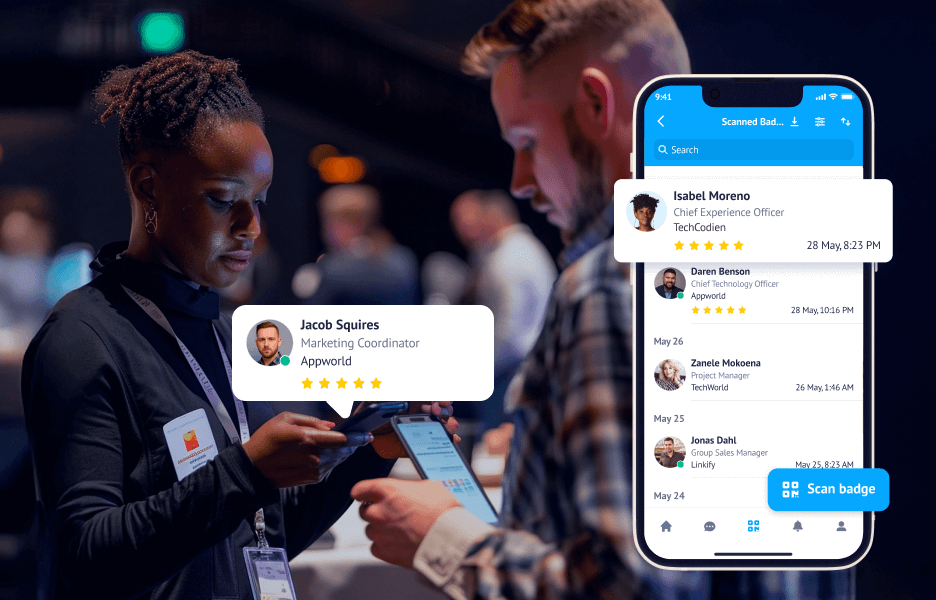
ExpoPlatform’s lead retrieval lets every member of a stand team scan badges and QR codes, rate and qualify contacts with custom questions and keep working offline when the venue WiFi drops, syncing data once it returns.
Because it sits inside the event app, visitor scans of exhibitor QR codes, session engagement and sponsorship activity all feed the same real-time exhibitor ROI dashboard.
Book a demo with ExpoPlatform to bring smarter event lead capture to your next show.
There's more you might like
Trade show lead capture: what are the key attributes?
The choice of trade show lead capture technology directly shapes how well prospects convert into opportunities. This article breaks down the core features of lead capture systems, answering the common questions: You’ll learn which attributes make lead capture effective, how event lead management tracks and nurtures prospects, and how privacy rules influence these tools—so you ...
How real-time lead data is proving event ROI
What is real-time lead data and why is it more important than ever for event organizers and exhibitors? As the name suggests, this data is almost instantaneously available the moment you capture the lead. Why is that important? It is now the driving force behind data-driven lead generation, with events as the vehicle. Said data ...
North America: Event mobile apps value to hit $832m by 2028
The North American event mobile app market is projected to exceed $830 million by 2028 – more than double its current value. Stats from Research and Market’s latest report show the technology’s worth will grow from $370.9m this year to $832.4m in six years. The body predicts a CAGR of 14.4% from 2022 to 2028 ...