 Download the Event Tech Forecast now



‘Exhibitions thriving in world where uncertainty is certain’
Exhibitions are thriving in a world where “uncertainty is certain” thanks to a long history of dealing with disruption, according to an industry leader.
Chris Skeith OBE, CEO of UFI, argues the sector has become “insanely good at dealing with disruption” and is now moving toward a state of permanent operational readiness.
It was highlighted how organizers are still growing in markets facing a huge range of challenges.
He said: “Uncertainty is certain. We’re insanely good at dealing with disruption – we always have been.
“Whether this be snow on the opening day of spring fair, whether this be travel disruptions.
“What’s different is that rather than doing a tabletop exercise once a year to brush up on it all, they’re now on the desk ready to deploy when you can.
“From an operational perspective, we’re very adept at change. What we’ve got to be super cautious of is our customers might not be.”
Get your copy of the Event Tech Forecast 2026 here.
Chris emphasized that “change is the norm” for an industry that has historically thrived in volatile emerging markets.
The perceived stability of the last two decades was actually “the thing that was out of the norm” for the trade show business.
He highlighted how exhibitions still continue to expand into high-risk territories – despite the rising frequency of global crises.
Chris said: “Exhibition organizers are still growing – they’re in emerging markets, they’re in markets where there’s change of regimes, they’re in markets where there’s environmental disasters. We go wherever the markets are.”
Be cautiously bold with fresh event formats
Meanwhile, more than a third of industry professionals want a wholesale rethink of the traditional model amid calls to be “cautiously bold” with fresh formats.
New figures from the latest UFI Global Exhibition Barometer reveal 37% of respondents see a definite need for an overall update, while 58% believe it depends on the type of show.
It comes as Chris told organizers to be brave – but not reckless – with new ideas.
He told the Event Tech Forecast 2026: “We create moments, we create memories. We shape careers, we forge lifelong relationships with people. We help shape industries. We make a difference to society. Fundamentally, we’re a people business.
“You can be innovative with your formats, but you’ve got to listen to your customers to deliver what they want. You’ve got to be bold, but cautiously bold. You need to research your market to understand it all.
“An event is a bunch of ingredients from which you can make many different meals. You’ve just got to make sure that you’re trying to get the right ingredients to make a success at the end of it.”
The industry landscape shows a definitive move away from a hope-and-pray model of networking.
Organizations face incredible pressure to justify the cost of attendance, meaning interactions must be more purposeful and data-backed.
Chris champions this shift by viewing the modern event as a collection of specialized components designed to drive value.
Organizers can now select from a range of meeting formats that serve as the “right ingredients” for their specific audience.
Carefully researching the market and listening to attendee needs means organizers can assemble a smorgasbord of formats to ensure a high return on time and foster the trust necessary for long-term business relationships.
Respondents to the Global Association of the Exhibition Industry’s barometer emphasise interactivity and engagement as the top priorities for a refresh, with around a fifth choosing these areas.
Reimagining Connection Spaces: Context, Value and Demographics
This move requires a shift from static networking to dynamic environments that respect the diverse needs of communities.
The value of these spaces is found in their ability to serve as a “conduit to connect that community” while providing a variety of formats to suit different professional stages.
- Senior Leadership and Safe Spaces: High-level demographics need the focus to be on depth and privacy over volume.
- Contextual Community Building: Networking formats are increasingly designed to help participants “extend their network, their community and knowledge” rather than just facilitating a simple transaction.
- The Gen Alpha and Tech-Savvy Shift: Traditional formats still hold value for established professionals – but newer demographics often prefer high-paced, tech-integrated formats.
- The Comfort Factor of Data: Demographics at all levels require “comfort factors” provided by data. Technology acts as an enabler to prove the return on time.
Modern events utilize a suite of purpose-built meeting formats that cater to different levels of seniority and intent.
Leveraging AI-powered event platforms means organizers can move beyond simple networking to facilitate deeper professional connections.
- High-Level Strategic Exchange: Formats like Board Meetings allow an exhibitor to present to a targeted group of buyers in pre-scheduled, private sessions.
- Curated Content Formats: Organizers are increasingly using Exhibitor Events where sessions are organized directly by exhibitors for specific attendee groups.
- Automated Peer-to-Peer Networking: Round Tables are now being scheduled automatically by organizers to ensure that like-minded professionals are grouped together based on shared interests.
- The VIP Experience: Hosted Buyer Programmes and Concierge Meetings use a mix of automation and human facilitation to pre-arrange high-value meetings between selected buyers and exhibitors.
- Speed Networking: Time is precious. This format sees an advanced matching algorithm pair participants for short, high-value sessions based on interests, goals and compatibility to maximize the value of limited networking time.
Competing with time, teams and tech
The biggest threat to an event’s success is not necessarily a rival show but the growing time pressure on delegates, according to Chris.
He believes time has become the scarcest resource for attendees so organizers must now justify the cost of taking professionals away from their desks.
Success is increasingly being framed as “return-on-time” where delegates assess whether attendance delivers against clear objectives and if the experience warrants the opportunity cost.
Chris said: “We have to be competitive against the time pressure and cost of our delegates attending the event. We need to make sure that we’re super valuable.
“It’s got to be a good return-on-time and objectives and experience.
“The biggest competitor that you face is that of time. People come with purpose. There’s an investment in their time.
“We’re years beyond putting people in a room and hoping the magic happens.”
The other big theme Chris has highlighted is competition is no longer limited to outperforming rival operators – it also involves internal benchmarking.
Large businesses risk operating in silos as they expand, while value must also be extended beyond a single focal moment.
He said: “I want us to be competitive with ourselves in relation to data. As businesses grow it’s harder to keep a handle on everything and integrating things across different activities is really important.
“We’re challenging ourselves and being competitive with ourselves about making sure that the content that the members create is then shared with more members.”
This competitive spirit is the main driver for adopting new technology among eventprofs.
Figures from the 2026 forecast reveal staying competitive and innovative is the primary driver for 34% of organizations.
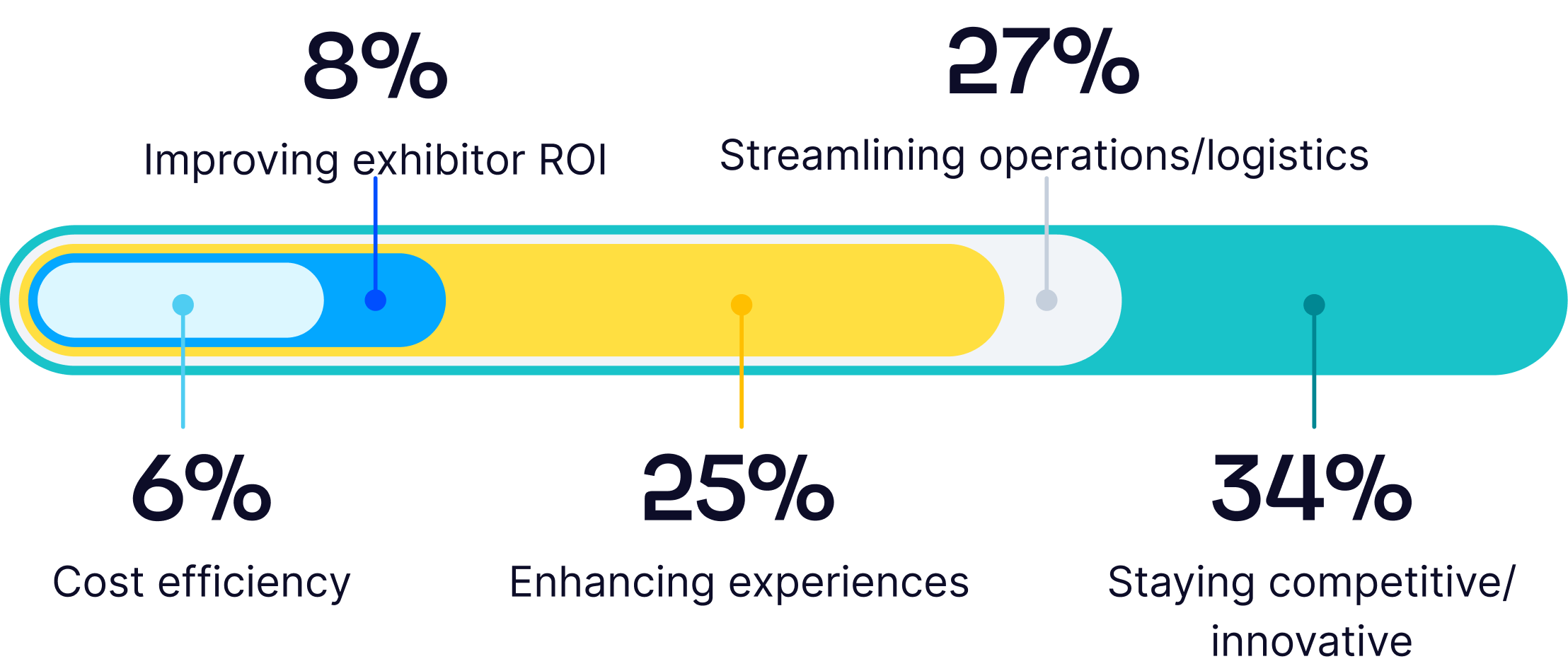
Enhancing attendee and exhibitor experiences and streamlining operations are also critical motivators.
Improving exhibitor ROI is the main driver for only 8% of respondents this year.
This reflects a shift toward internal efficiency and experience-led adoption.
Chris Skeith OBE: “Our objective is to help people extend their network, community and knowledge.
“Organizers are using tech as an enabler to do that – to understand more, to help curate experiences, but also help create uncurated experiences as well, to surprise and delight.
“We’re competing for time and attention from our customers. We have to be competitive against the time pressure and cost of delegates attending the event. We need to make sure that we’re super, super valuable.”
Thank you for reading. Get more insights from Paul, other expert contributors and analysis of the global survey data in the Event Tech Forecast 2026.


There's more you might like
Exhibitions face innovation ‘perception gap’ as AI reality sets in
Exhibition businesses appear to be navigating a “notable” disconnect between public innovation claims and actual digital adoption, according to Event Tech Forecast findings. New global survey data in the report by ExpoPlatform reveals 74% of firms position themselves as leading innovators, while 45% admit artificial intelligence has yet to meaningfully impact their business models. Kai ...

Hyve moves further into health sector with latest takeover
The largest conference of its kind in the US for behavorial health profs has been taken over by Hyve. Behavioral Health Tech is the latest in a string of acquisitions for the organizer – marking their fourth in a year. That’s your top story for the Week in Events. Here are some other highlights for ...

Events industry prepares for IMEX Frankfurt
The global events industry is gearing up for a busy week as IMEX Frankfurt 2025 prepares to welcome professionals from over 100 countries, with strong buyer interest and a packed agenda of announcements and activations. Hyve Group is expanding its portfolio with the launch of Breakbulk Asia in Singapore, while Bar Convent Berlin sets the ...