 Download the Event Tech Forecast now



Free Event Strategy Bot launched to help organisers grow
A new AI-powered tool has been developed to create a full strategic analysis of any show in minutes – and it’s being given away for free.
Baris Onay, founder of Precision Communities, created the Event Strategy Bot to help organisers quickly understand and benchmark their events.
It was born from his own consulting work with mid-sized companies and designed to make event analysis “as easy as possible”.
He told ExpoPlatform: “In my line of work, I work with lots of mid-size organisers that tend to be in the five to 50 million revenue range, with multiple events around the world.
“When I’m helping them build their portfolio or through digital transformation, first I need to learn about their events.”
This process used to be manual – researching websites, noting target industries and comparing event footprints.
But the repetitive nature of that work led him to look for a better solution.
Baris said: “I found myself repeating the same thing with my checklist, manually and all that stuff. Sometimes when I have multiple projects it’s a bit overwhelming, so I need to really throw myself into learning about some events – then enter ChatGPT.
“I started working with ChatGPT on this and teaching it how to look at an event.
“It started as a single prompt I was writing, then got longer, it started becoming a memory when they turned on memory a few months ago. That memory became a process.”
From personal project to public tool
What began as an experiment to save time soon turned into a powerful internal assistant.
Baris built his own bot – trained specifically on his 20 years of event strategy experience – to automate research and analysis.
He said: “For my own self, I created the bot, a custom GPT in its own container, where it runs much faster and much more rigidly.
“I would throw in just a URL of an event. It would tell me everything I needed to know.
“It became my pet project. I played with it, played with it, played with it.
“Then it came to a corner – I said, ‘Hey, this is cool. Let’s sort it out,’ because then I put it out and sent it out to my own list of people.
“And it became such a thing all of a sudden, because people saw value in it.”
The positive feedback convinced him to make it available to everyone.
He said: “I polished it a bit and now it’s up there, free to use wherever anyone else.”
How the Event Strategy Bot works
The concept is simple: enter the URL of any event website and the bot delivers a 10-point strategic report in about five minutes.
Baris said: “I made it as easy as possible. The only input you need is the URL of the show you want to analyse.
“It might be your own show, your competitor’s show – just the URL – and wait five minutes and you get a 10-point strategy out. It doesn’t get easier than this.”
He added: “You can also run it on your competitors, or if you’re having M&A targets, you can put the bot on one of those and see what it does for you. It will give you a very nice overview of your target show.”
The bot doesn’t just summarise – it compares, analyses and predicts.
It also gives users an overview of the historic performance.
Baris said: “It comes up with a comparison table to your competitors, does a sector analysis, looks at the sectors in your show and your competitors’ shows, finds growth numbers globally for those sectors and then combines where you should be growing and how to look at your strategy.”
It even creates an industry events calendar, analyses content, partnerships as well as technology and ends with a synthesis report outlining where to play and how to win.
A starting point for strategy
Baris emphasised that while the tool is powerful, it’s designed as a foundation – not a replacement for human insight.
He said: “Once you get that, of course, read it and make sure that it’s not making stuff up.
“After you do that, you will have questions. Just ask it directly.
“You can start talking as if it was a strategy consultant, because I taught it how to act like a strategy consultant – in events specifically.
“So that’s what I mean when I say play with it. Don’t just stop by taking the 10-point strategy and putting it on the wall – you can actually play with it.”
However, the bot can’t replace the real work of team strategy sessions or execution planning.
Baris said: “What it doesn’t do is sit with your teams and tell them what to do, or come up with how to attack this – that’s what I do.”
Despite its usefulness, Baris chose to make the Event Strategy Bot publicly available at no cost. For him, the real value lies not in the output, but in what organisers do with it.
He said: “People ask me, why is it free? Because for me, in my line of work, the value is not in what it does, but in taking it and actually deciding what to do with it and doing it.
“It distils my 20-plus years of my view of how I look at events and it does a pretty good job at getting to a starting point of a strategy that you can take forward and play with.”
Make event tech invisible
Meanwhile, Baris believes the current event tech landscape is too fragmented, forcing users through clunky systems that undermine the experience.
He told ExpoPlatform that organisers need to take inspiration from companies like Revolut, where technology quietly enables a frictionless customer journey.
Baris said: “The best technology is invisible technology. If no one thinks there is something like event tech it’s the best place they can be.
“Some of the event technology is very visible and that will need to change at some point.
“If I have to get a login for a customer portal and another login for the app and another login at the registration and those three don’t talk to each other – that’s a problem.”
The benchmark for good technology is simple: users shouldn’t have to think about it.
Baris pointed to the example of digital banking, where seamless authentication and integration make the entire process feel effortless.
He said: “If you look at the customer experience of some other sectors out there, you log in once and everything happens.
“In our companies, we use Revolut and they’re amazing, because the login process is, I got the app, I look at my phone and my computer lights up. It’s working.”
Baris added: “That is invisible technology. If we can push the customer experience in events towards that, then that’s the right approach – not worrying about things.”
A fragmented playing field
It was warned that event organisers risk falling behind if they fail to address the growing complexity of their technology stacks.
Baris described a marketplace where multiple systems are bolted together, creating inefficiencies and technical debt that eventually slow innovation.
He said: “There is a new player coming up – disruptive, very well funded – that might create an end-to-end system, which is amazing. But one of them creates a lot of technical debt, because those systems that they buy actually don’t talk to each other.”
It was added that some technology providers are trying to build holistic solutions from in the industry rather than through acquisition.
Baris believes “joined-up” innovation could lead to a new standard in event technology – one that feels as natural and connected as the best consumer apps.
Power imbalance between organiser and user
Another barrier to progress, according to Baris, lies in how event platforms are chosen and controlled.
He argued that end users – the exhibitors, attendees and visitors – often have little say in the technology they are required to use, creating a disconnect between expectations and delivery.
Baris said: “The user is not empowered. The organiser decides and the organisers generally run monopolies.
“Their shows are the big ones. They’re not in a competitive situation. They are the leading show of a certain industry in a certain market, so they have no competition.”
It was claimed this lack of competition can lead to complacency.
However, Baris pointed out that corporate event organisers – such as large vendors hosting their own meetings – often hold themselves to higher standards.
He said: “Let’s be blunt – in exhibitions, there is no drive to really give an incredible customer experience so that the customer is happy, because the customer is so far away.
“That’s the main problem with the evolution of events – the power is in the hands of very few, not the many.
“If you flip that coin to corporate events – where the big vendor is doing their own events – it has to be incredibly slick.
“The corporate events world, with extensive use of specialised agencies are considerably advanced in the customer experience side of things.”
Baris added: “Technology should strive to be invisible and create an actual brilliance in customer experience that just works. ‘This was good, therefore the show was good, so I’m going to rebook.’ That’s how it should feel.”
Thank you for reading this article. Want to see how event tech can help turn these insights into action? Book a free consultation with ExpoPlatform now.
There's more you might like

UFI stands in solidarity with Middle East events community
UFI has express its solidarity with Middle East events community amid military escalations across the region. The organization has released a statement which sets out the safety and wellbeing of industry professionals is at the top of its minds and of paramount importance. Here are your other top headlines from the events industry this week: ...
The Event Data Crisis: Why detached leadership fails
Event chiefs might have grown too detached from their own exhibitions to understand where they are failing on experiences, according to an industry strategist. Barış Onay, founder of Precision Communities, argues organizers are hiding behind expensive technology to mask the disorganized state of their underlying data. He believes industry bosses need to step up and ...
Event meeting formats: which should you choose for your next show?
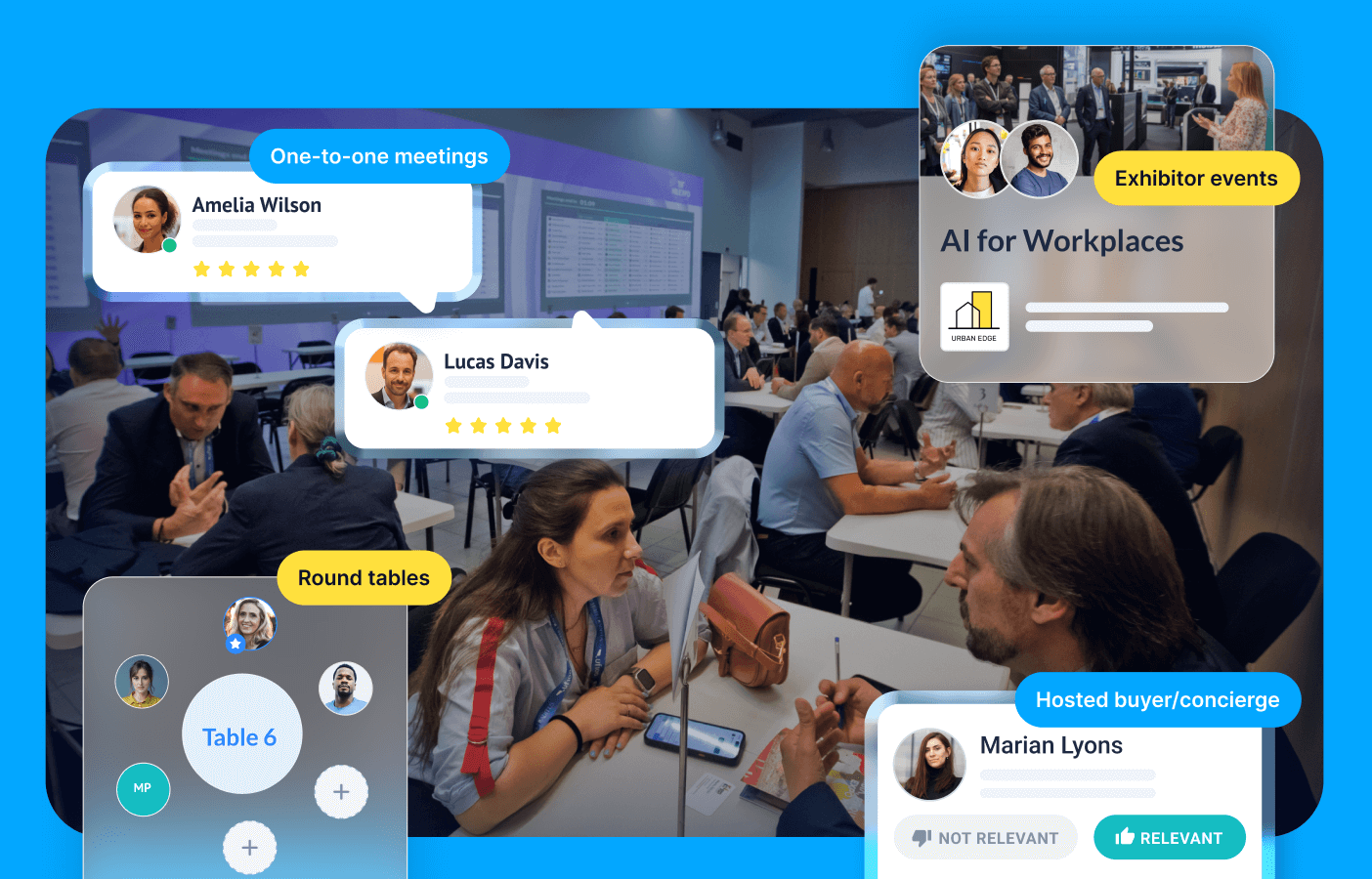
There is a range of event meeting formats available, but finding the right one to your purpose is where it matters. Attendees and exhibitors increasingly want hyper-personalized experiences that make it easy to achieve their goals. The expectation and pressure are on organizers to provide the correct formats to facilitate this. So what are the ...