 Download the Event Tech Forecast now


Out-of-the-box AI ‘not good enough’ for eventprofs
Generic tools don’t cut it for the specialized world of B2B exhibitions and organizers must now cross the “second door” of personalization, according to an industry expert.
Stephan Forseilles, chief digital officer at Easyfairs, argues the market has moved past the era of asking “how” to do things and is now stuck wondering which tools to use properly.
It comes amid fresh figures from the Event Tech Forecast 2026 which show the industry is seeing limited impact from tech despite organizers feeling like they are leading the way in innovation.
He said: “Out of the box AI is not good enough. You really have to put in the effort to select which model you want to use or which prompt you want to use in the different areas.
“From the beginning people said that prompting would be very important. Now we really see that it’s actually even worse than that.”
Organizers face a strategic dilemma as they move into 2026 – the initial excitement of artificial intelligence has hit a plateau because many users are failing to move beyond basic applications.
This self-assessment among eventprofs indicates a high level of individual use but the broader organizational impact remains elusive.
Stephan – an expert contributor to the Event Tech Forecast 2026 – added: “Even the topic of AI is ubiquitous. It’s everywhere.”
The end of the free lunch
Another issue identified by Stephan is the risk of using off-the-shelf software for sensitive B2B data.
Many firms have banned the use of public platforms like ChatGPT or Gemini to protect their intellectual property.
It comes as the industry is moving toward a custom-built approach where organizers develop their own frameworks to ensure security.
Meanwhile, the forecast shows that efficiency gains are often limited because users do not personalize their tools.
Stephan compares the current state of AI to a “two-room house” where most people never make it past the front door.
He said: “You enter the first room and it’s wonderful. You see there are so many possibilities.
“Then you actually realize that it’s always a little bit off or my special case is not treated.
“You have to make the effort to go through that second door, which is personalizing.”
Organizers can overcome this by building proprietary systems which allow staff to select models like Claude or Gemini via enterprise APIs that guarantee data is not used for external training.
Stephan said: “There’s no such thing as a free lunch. I think we passed the free lunch era of the LLMs.
“Why would ChatGPT give you free access if they didn’t have any advantage of using your data to train their model? I don’t think they would do that.”
The Ferrari problem and specialized agents
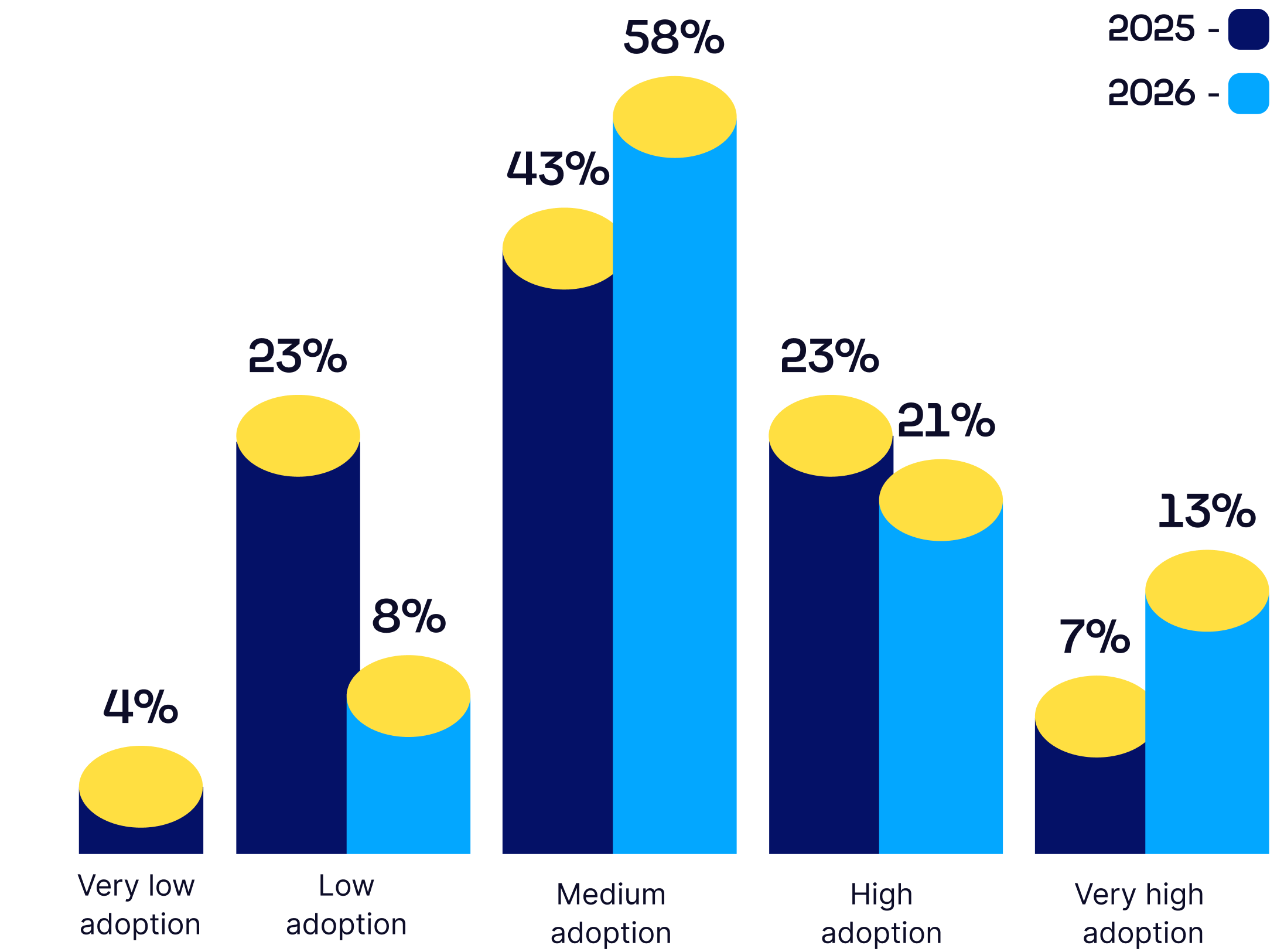
A huge barrier to deeper transformation is the “shallow” adoption of technology, with the report showing 23% still report uptake as low at their events.
Many event professionals treat AI like a high-performance vehicle but lack the training to drive it.
The survey data suggests limited efficiency gains because – potentially because users expect perfection without putting in the work to refine the output.
Stephan argues the real productivity boost happens when you train specific agents for specific tasks – different prompts for team meetings, product demos, webinars and one-to-one sessions.
He said: “Basically you buy the Ferrari or the Porsche and then you drive it and you say, ‘Okay, but anyway, it’s dangerous. I cannot drive it fast enough.’
“Then you actually learn to drive it and you go on the track with it and then you realize that it’s actually a very good car. It’s the same for AI.”
Data hygiene and the one-click badge
Integration with existing systems remains the number one digital challenge for 74% of event professionals.
However, Stephan believes the problem is not the technology itself but the underlying data models.
The “plumbing” of integration has become easy through drag-and-drop tools but the lack of common terminology creates friction.

He said: “Integration is easy. There are so many good tools to make integrations. What’s difficult is the underlying data models. We lack a common data model that represents what we do across the different tools. This is where the shit hits the fan.”
This lack of cohesion prevents the industry from reaching its “gold mine” – the ability to provide B2B customers with deep industry insights.
B2C giants like Amazon and Meta know everything about their users, but data collection remains difficult because exhibitions are primarily face-to-face.
Stephan identifies several areas where data strategy must evolve:
- Registration Friction: Organizers often ask too many questions just for the sake of “making a pie chart” which wastes visitor time.
- Behavioral Tracking: Technology like NFC smart badges allows organizers to see what products people are actually touching rather than asking them what they like in a form.
- Cross-Show Standards: Using different product categories for different shows in the same portfolio makes it impossible to track returning visitor behavior accurately.
Stephan added: “If I have 5,000 visitors and they all spend 10 seconds answering your question, you’ve cost humanity 50,000 seconds of their life. Is it worth it for the pie chart? I don’t know – especially if you have another way to find out.”
The Agentic Future: MCP in 2026
Meanwhile, Stephan set out how a new technical standard called Model Context Protocol (MCP) is becoming the “core” of efficient AI in event technology.
This allows different AI models to communicate with each other and share context.
It enables a “highway” of agents where one model translates a document while another summarizes it and a third creates related images.
Stephan said: “It’s a bit technical but it’s MCP. We’re starting to use MCP more and more. It came out in 2024 already but we really started using it in 2025. I think it’s going to be at the core of what we do with AI in 2026.”
This move toward an agentic company requires a fundamental shift in hiring.
Stephan argues the smartest decision an event organizer can make for 2026 is to secure high-level technical talent regardless of the cost.
He said: “Get the smartest people, tech people you can find, whatever the price. Because the good ones are rare. And hang on to them.”
The traditional role of the event organizer is shifting from a space provider to a data-driven consultant.
To survive this transition firms must move past the “AI powered” marketing badge and start delivering real value through clean data and specialized agents.
Thank you for reading. Get more insights from Stephan, other expert contributors and analysis of the global survey data in the Event Tech Forecast 2026.

There's more you might like
The AI Roadmap for Events 2026
The event show floor is alive with data – signals, interactions and choices – waiting to be transformed into insight. AI is the invisible backbone of modern events, orchestrating everything from matchmaking to follow-up. It’s the greatest enabler. Your goal is not to make events more automated – but to make them more personal, impactful ...
Exhibitions face innovation ‘perception gap’ as AI reality sets in
Exhibition businesses appear to be navigating a “notable” disconnect between public innovation claims and actual digital adoption, according to Event Tech Forecast findings. New global survey data in the report by ExpoPlatform reveals 74% of firms position themselves as leading innovators, while 45% admit artificial intelligence has yet to meaningfully impact their business models. Kai ...
The key elements that define AI-powered events
AI-powered technology is constantly evolving to meet the priorities of event professionals. It’s triggered a shift in how events enable businesses to meet their goals – even impacting the amount of marketing budget allocated to live shows. Production, engagement, data analysis and overall experiences are improving – but what are the key elements of an ...